Confined Space Entry Language Barrier: Safety Guide
By New Heights Languages ·
Overcome the confined space entry language barrier. Improve pre-entry briefings, permit compliance, and attendant communication for non-English crews.
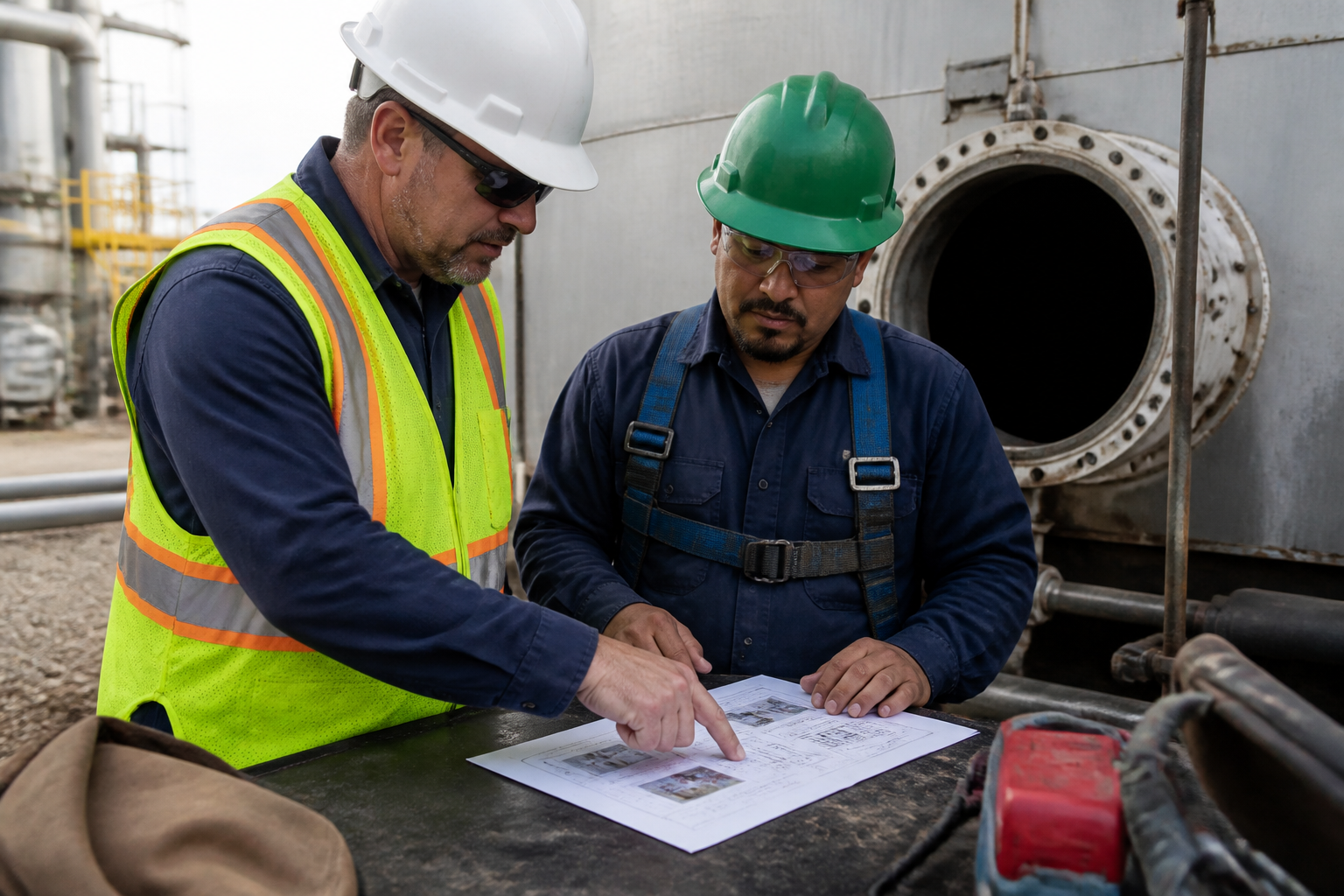
The Life-Safety Risk Behind Pre-Entry Briefings
Confined spaces—such as storage tanks, sewer vaults, grain silos, utility pits, and digesters—present some of the most unforgiving hazards in manufacturing and construction. Atmospheric toxicity, oxygen deficiency, engulfment risks, and mechanical hazards leave zero room for error. While safety managers invest heavily in calibrated gas detectors, tripods, and ventilation blowers, many jobsites remain vulnerable because of a critical communication gap.
When non-English speaking crews enter permit-required spaces, eliminating the confined space entry language barrier during pre-entry briefings is a vital safety requirement. A worker who nods in agreement during a shift start meeting may not fully grasp the specific atmospheric threshold that requires immediate evacuation or the exact lock-out sequence performed on an agitator blade inside a vessel.
Where Language Barriers Compromise Confined Space Permits
OSHA standard 1910.146 for general industry and Subpart AA (1926.1200) for construction require clear designation of three distinct roles: the Entry Supervisor, the Authorized Entrant, and the Attendant. Each role carries strict responsibilities that depend entirely on real-time communication.
When a confined space entry language barrier prevents clear understanding between these roles, compliance breaks down in three specific areas:
1. Permit Verification and Hazard Recognition
The entry permit is a live contract detailing acceptable entry conditions. If an entry supervisor conducts a quick pre-entry briefing in English to a Spanish-speaking crew, workers may sign the entry log without understanding what hazards were tested or what ventilation parameters are required.
2. Attendant-to-Entrant Monitoring
The attendant must stay outside the space, maintain continuous count of entrants, and communicate constantly to monitor worker status. If an attendant detects a behavioral change caused by toxic gas exposure or low oxygen, but lacks a clear shared language with the entrant, critical seconds are lost in issuing an evacuation order.
3. Emergency Evacuation Procedures
Non-entry rescue protocols depend on immediate response. If an alarm sounds on a four-gas monitor or an external warning occurs, non-English speaking workers must instantly recognize the warning signal and execute the designated exit path without hesitation.
Critical Terminology for Multilingual Entry Crews
To maintain complete jobsite safety, employers must move beyond generic translation apps and equip crews with job-specific, operational English and Spanish safety terms. Every employee on the crew—regardless of their primary language—must understand these key operational phrases:
- Permit-Required Confined Space / Espacio Confinado Que Requiere Permiso: A space with known or potential atmospheric hazards, engulfment hazards, or internal configuration risks.
- Attendant / Acompañante de Entrada: The dedicated worker stationed outside who never leaves the entry point and monitors employees inside.
- Authorized Entrant / Entrante Autorizado: The trained worker approved to physically enter the space to perform work.
- Oxygen Deficiency / Deficiencia de Oxígeno: An atmospheric reading below 19.5% oxygen concentration.
- Lower Explosive Limit (LEL) / Límite Inferior de Explosividad: The minimum concentration of a combustible gas in air that will burn or explode.
- Evacuate Immediately / Evacuar Inmediatamente: The mandatory directive to drop tools and exit the space using the retrieval system or ladder.
- Ventilation Blower / Soplador de Ventilación: Mechanical equipment forcing fresh air into the space to maintain safe atmosphere.
- Lockout/Tagout (LOTO) / Bloqueo y Etiquetado: Isolation of all energy sources before entering the space.
Restructuring the Pre-Entry Briefing for Clear Verification
A compliant pre-entry briefing cannot rely on passive listening. Supervisors must shift to active verification methods that prove every entrant and attendant understands the hazards before breaking the plane of the space.
Implement Call-and-Response Sign-Offs
Instead of asking "Do you understand?", supervisors should ask entrants to point to the gas monitor screen and identify the alarm set points. Require entrants to state in their own words—or through a bilingual crew leader—what specific signal means immediate exit.
Standardize Visual Safety Indicators
Combine clear verbal instructions with physical visual checks. Match atmospheric gas monitor readout screens with color-coded safety badges (Green for clear, Red for alarm). Ensure physical LOTO tags match the line numbers recorded on the posted entry permit.
Train Attendants and Entrants Together
Never train attendants and entrants in isolated language groups. Conduct joint scenario drills where attendants practice issuing evacuation orders and monitoring entrant responses across real floor conditions.
Bridging the Communication Gap on the Shop Floor
Addressing the confined space entry language barrier before workers enter a tank or pit prevents costly OSHA citations and protects lives. When entry supervisors, attendants, and entrants share a practical, jobsite-tested vocabulary, permit verification becomes an active safeguard rather than an administrative formality.
At New Heights Languages, we specialize in custom, practical English and Spanish training designed specifically for manufacturing plants and construction sites. We help your supervisors conduct rigorous pre-entry briefings and give your frontline workers the precise vocabulary needed to operate safely in high-hazard environments.
Ready to improve safety communication and permit compliance across your multilingual workforce? [Book a free consultation today](/contact) to discuss customized workplace language programs tailored to your facility.
<!-- featured image alt: A construction supervisor reviewing a confined space entry permit with a Spanish-speaking worker outside a storage tank. -->