How to Give Clear Instructions ESL Workers Understand
By New Heights Languages ·
Discover practical supervisor strategies to give clear instructions to ESL workers on the plant floor, reducing errors, rework, and safety hazards.

When high-volume production lines are running, clear communication isn't optional—it's an operational necessity. Yet on many plant floor shifts, supervisors struggle with giving clear instructions ESL workers can follow during fast-paced operations. A supervisor might deliver a rapid three-step task, get an affirmative head nod, and walk away—only to return an hour later to find the wrong raw materials loaded into a hopper or a machine setup completed incorrectly.
This disconnect rarely stems from a worker's lack of effort or technical skill. Instead, language barriers make processing fast, spoken English under noisy, stressful floor conditions difficult. When communication relies on assumptions, errors multiply, rework increases, and safety risks surge. To keep operations running smoothly, plant leaders must equip their line managers with micro-behaviors that guarantee understanding on the first pass.
Stop Asking "Do You Understand?": Use Teach-Back
The default habit for many busy supervisors is asking closed-ended questions like, "Does that make sense?" or "Do you understand?" On the factory floor, almost every employee will nod and say "yes."
In many cultures, admitting a lack of understanding to a manager is seen as disrespectful, incompetent, or risky for job security. Employees often nod to acknowledge that they heard you speaking, not that they comprehended the command.
To ensure real comprehension, supervisors must replace closed-ended questions with the "Teach-Back" technique. This method requires the employee to demonstrate or restate the instruction in their own words before starting the task.
How to Apply Teach-Back on the Floor
Instead of asking if the direction was clear, supervisors should use open-ended prompts:
- "Show me where those rejected parts go."
- "What target temperature do we need before starting this run?"
- "Which valve do you turn off first when the alarm sounds?"
If the worker cannot answer or demonstrate correctly, the supervisor immediately knows the instruction was missed—without making the employee feel singled out or embarrassed.
Strip Down Sentence Structure on High-Noise Lines
When attempting to give clear instructions ESL workers can process quickly on busy lines, a supervisor's natural conversational habits often get in the way. Native English speakers frequently use filler phrases, idioms, and multi-clause sentences that overwhelm non-native speakers.
Phrases like "If you get a chance, go ahead and clear out that bay whenever you finish up over here" contain far too many unnecessary words. A worker processing English as a second language has to translate every filler word before identifying the primary action.
Action-First Directives
Supervisors should speak in short, sequential sentences focused purely on the required actions. Eliminate filler words and state the action verb first:
- Avoid: "I'm going to need you to go grab the torque wrench and make sure these bolts are tightened down real good."
- Use: "Get the torque wrench. Tighten these four bolts to 40 pounds. Tell me when finished."
By removing conditional phrasing ("if you get a chance") and vague modifiers ("real good"), the core directive becomes instantly recognizable.
Pair Words with Physical Anchors
Spoken words disappear instantly, especially in high-noise manufacturing environments where earplugs are required. Giving directives purely verbally dramatically increases the likelihood of miscommunication.
When issuing orders, line managers should anchor every verbal instruction to a physical object, visual marker, or location on the floor.
Practical Anchoring Techniques
- Point to visual callouts: Never say "Put this over there." Say "Move this green tote to Bay 3," while physically pointing to the colored bin and the bay signage.
- Demonstrate physical motions: If setting a digital gauge or adjusting a feed rate, physically perform the movement once while stating the target value clearly.
- Use exact part numbers: Avoid generic descriptions like "the big fitting." Point to the physical label on the rack that matches the pick sheet.
When supervisors consistently pair physical references with concise speech, they create a redundant communication channel that bypasses language barriers.
Utilize Visual Task Boards for Multi-Step Sequences
For complex procedures like machine changeovers, preventive maintenance, or quality inspections, relying solely on verbal instructions is risky. Even native English speakers forget multi-step verbal directives given during a noisy start-of-shift huddle.
To support daily execution, supervisors should utilize physical visual checklists mounted directly at the workstation.
Key Elements of Floor-Ready Checklists
- Numbered sequences: Step 1, Step 2, Step 3 clearly printed in high-contrast text.
- Photo anchors: High-resolution photographs showing "Correct Setup" versus "Incorrect Setup."
- Standardized terminology: Simple English labels that match the exact language used in floor training.
When supervisors reference these physical boards during daily shift handoffs, they provide a permanent reference point that workers can consult throughout their shift without needing to stop production to track down a lead.
Foster a Floor Culture Where Clarification Is Safe
Workers will only ask questions if they know it is safe to do so. If a supervisor acts rushed, visibly annoyed, or uses a sharp tone when an instruction isn't understood, workers stop asking for help. Instead, they make an educated guess on the production line—frequently leading to costly scrap, downtime, or safety incidents.
Consistently giving clear instructions ESL workers rely on requires establishing a floor environment where asking for clarification is encouraged and respected.
Supervisor Behaviors that Build Floor Trust
- Maintain neutral body language: Avoid sighing, crossing arms, or shaking your head when an employee asks you to repeat a direction.
- Praise proactive questions: Explicitly thank employees when they stop to verify a tolerance setting before starting a run.
- Lower speaking speed, not volume: Speaking louder does not make English easier to understand. Slowing down speech cadence and pausing between steps gives workers time to process key vocabulary.
Build Long-Term Communication Strength Across Your Plant
Equipping line supervisors with clear instruction techniques solves immediate daily friction, but long-term operational excellence happens when language gaps are bridged across the entire facility. When frontline employees build practical, job-specific English skills tailored to your machinery, safety protocols, and quality standards, production speed increases and supervisor stress drops.
At New Heights Languages, we deliver customized, on-site workplace English and Spanish training designed specifically for manufacturing and construction environments. We help your frontline employees gain the exact vocabulary and comprehension skills needed to execute floor instructions correctly every single shift.
[Book a free consultation with our workplace language experts](/contact) to evaluate your plant's communication needs and explore tailored floor training programs.
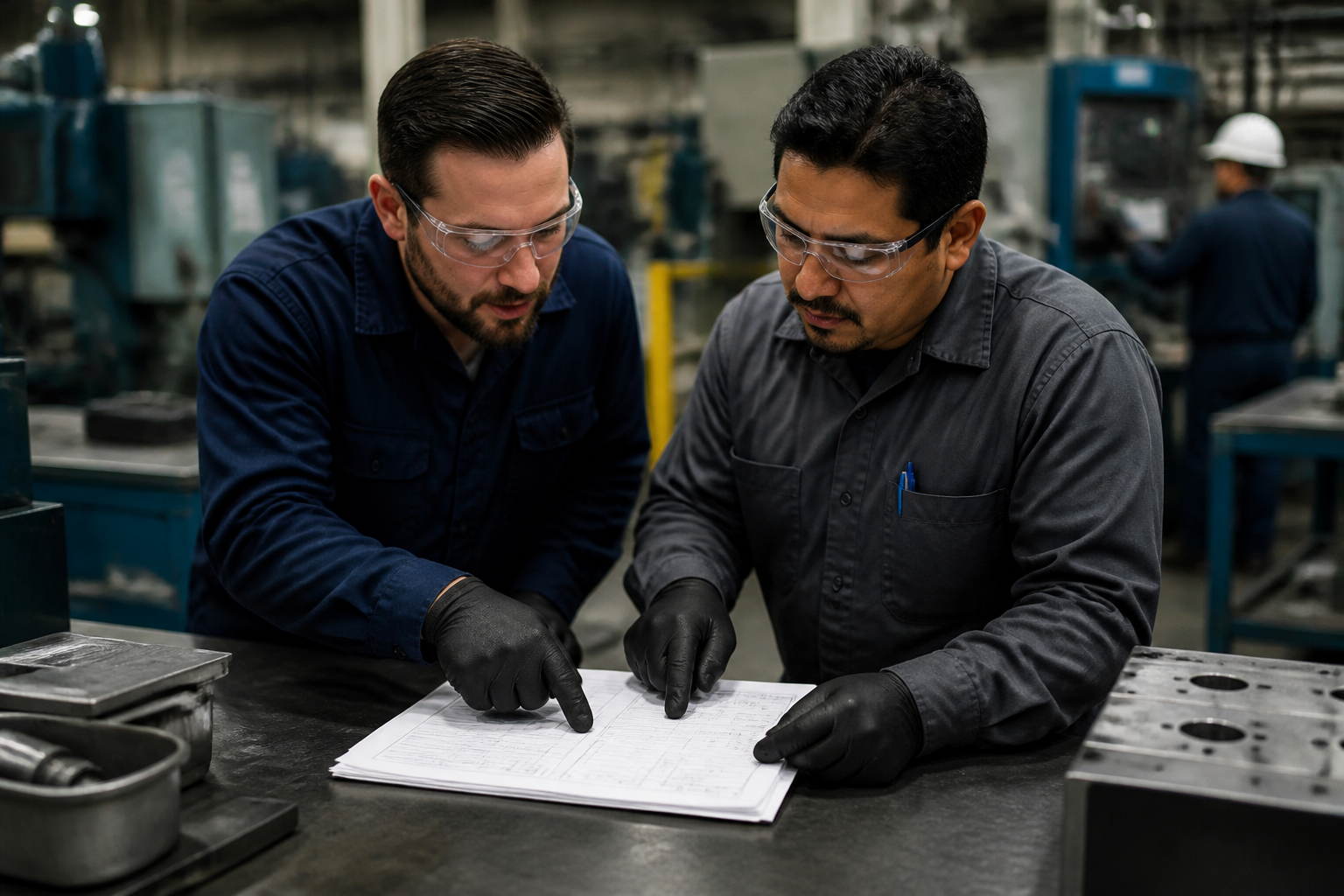
<!-- featured image alt: A plant supervisor pointing to a color-coded machine control panel while explaining operational steps to a frontline worker. -->