Language Class Scheduling Manufacturing: 24/7 Models
By New Heights Languages ·
Discover practical class scheduling models for 24/7 manufacturing plants. Keep shifts staffed while upskilling multilingual workers in workplace English.

Running a continuous 24/7 manufacturing plant leaves little room for operational disruption. When production lines run constantly across three shifts, pulling frontline team members for professional development seems impossible. Yet, leaving limited-English proficient workers out of training creates operational bottlenecks, quality deviations, and supervisory frustration.
Navigating language class scheduling manufacturing programs requires moving past traditional classroom frameworks. You cannot simply pull a full assembly team for two hours on a Tuesday afternoon. To upskill your workforce without sacrificing throughput, HR leaders and plant managers must deploy scheduling models designed specifically for continuous production environments.
Model 1: The Shift-Overlap Bridge
Many continuous processing facilities operate with a built-in 30-to-45-minute overlap between incoming and outgoing shifts for handoffs, prep work, and equipment line-outs. The Shift-Overlap Bridge capitalizes on this transitional window.
Instead of scheduling a single long session during active production, classes are split into tight, focused 30-minute modules delivered right at the shift boundary.
How It Works in Practice
First-shift workers stay 15 to 20 minutes past their normal stop time, while second-shift workers arrive 15 to 20 minutes early. The combined group meets in an adjacent training room or break area for a targeted, 30-minute workplace language session.
Operational Advantages
- Production lines remain fully staffed during standard operating hours.
- Off-shift overtime is capped at a manageable 15 to 30 minutes per employee per session.
- Incoming and outgoing crews learn identical operational terminology simultaneously, improving shift handoff quality.
Model 2: The Split-Batch Rotation
When shift overlaps are tight or nonexistent, pulling several employees from a single cell can stall an entire line. The Split-Batch Rotation solves this by grouping workers across parallel lines or departments rather than pulling an entire machine crew at once.
Smart language class scheduling manufacturing strategy relies on pairing cohort selection with cross-trained relief coverage.
Structuring the Cohorts
If a packaging line requires six operators, you select two operators from Line A, two from Line B, and two from Line C for Cohort 1. Float operators or utility relief personnel cover these specific stations during the 45-minute class window.
Once Cohort 1 completes their session and returns to the line, Cohort 2 steps off for their scheduled block.
Key Implementation Guidelines
- Stagger class times: Schedule Cohort 1 at 10:00 AM and Cohort 2 at 11:00 AM.
- Protect utility floats: Ensure float workers are fully trained on those specific machines before class day.
- Maintain line balance: Never pull more than 20% to 25% of any single sub-assembly crew at one time.
Model 3: Pre-Shift and Post-Shift Embedded Blocks
For high-speed automation plants where floating operators during live production creates unacceptable risk, scheduling classes directly adjacent to shift starts or ends is the cleanest approach.
The Pre-Shift Model (Best for 2nd and 3rd Shifts)
Night shifts often struggle with training engagement when sessions are scheduled mid-shift or on days off. Delivering a 45-minute language block immediately before 3rd shift starts ensures high energy levels and strong attendance, as employees are already commuting to the facility.
The Post-Shift Model (Best for 1st Shift)
Day-shift employees often prefer completing training before heading home. Scheduling a 45-minute class directly following the end-of-shift whistle keeps training predictable and avoids off-day disruptions.
Managing Wage & Hour Compliance
When using embedded blocks, always pay workers for training time. If training pushes an employee past 40 hours for the week, factor non-exempt overtime rates into your operational budget. Trying to force unpaid or mandatory off-site language training leads to low attendance and employee turnover.
Model 4: Dedicated Maintenance & Downtime Windows
Plants that utilize continuous 2-2-3 schedule rotations or designated weekly sanitation shifts can leverage planned downtime for language development.
Capitalizing on Maintenance Windows
Most 24/7 operations pause specific lines for 2 to 4 hours weekly or bi-weekly for preventative maintenance, deep cleaning, or tooling changeovers. Scheduling training during these scheduled lulls allows workers to complete coursework without impacting Overall Equipment Effectiveness (OEE).
Rotation-Based Scheduling
For plants operating 12-hour shifts on a 2-2-3 cycle:
- Classes are scheduled on fixed workdays within the rotation.
- Instruction repeats across opposite shift schedules so both Crew A and Crew B receive equal access.
- Content is delivered in modular units so a worker missing a session due to urgent maintenance coverage can catch up easily.
4 Non-Negotiable Rules for 24/7 Scheduling Success
Regardless of the model you select, successful execution depends on clear operational boundaries:
- Equal Access for Night Shifts: Never restrict English or Spanish training to 1st shift. 2nd and 3rd shift crews handle critical off-peak operations and deserve identical upskilling opportunities.
- Dedicated Space Near the Floor: Do not make workers walk 10 minutes to an administrative conference room. Use a clean, quiet space adjacent to the shop floor to minimize transition downtime.
- Supervisor Buy-In: Plant supervisors must review and approve class rosters two weeks in advance so they can adjust staffing schedules and planned breaks.
- Consistent Floor Terminology: Instruction must directly reflect your facility's actual equipment names, safety tags, SOPs, and quality documentation.
Build Your Plant's Custom Schedule
Every manufacturing facility has unique shift patterns, staffing constraints, and throughput demands. A rigid, off-the-shelf course will fail on a continuous production floor.
New Heights Languages designs tailored language class scheduling manufacturing models that fit your exact shift structure—ensuring your workers gain job-critical English or Spanish skills without slowing down your lines.
Ready to upskill your floor workforce without compromising plant productivity? [Book a free consultation with our team](/contact) to evaluate your schedule and build a customized training plan.
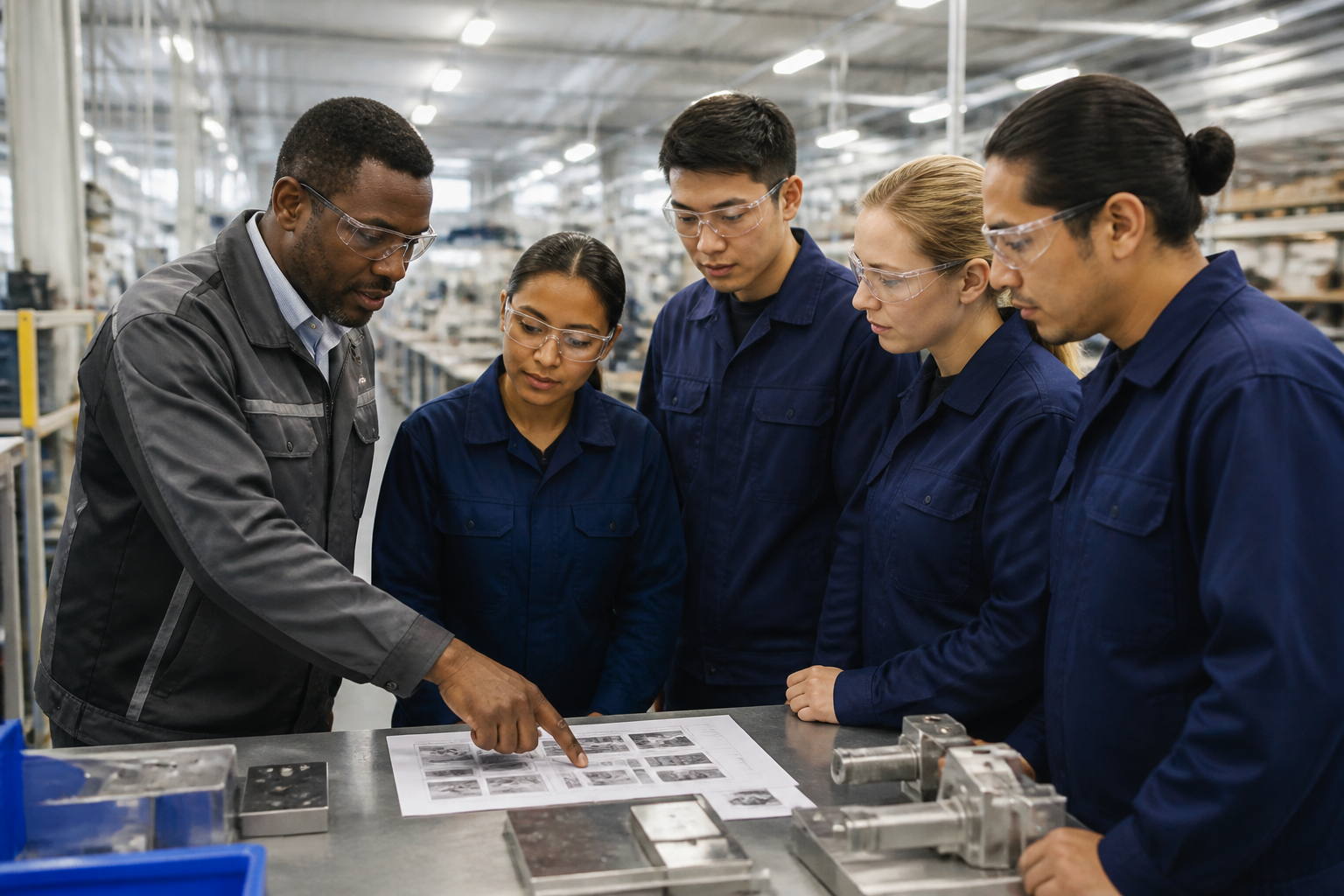
<!-- featured image alt: A plant supervisor and multilingual manufacturing workers discussing shift schedules near an operational production line. -->