Last Planner System Multilingual Construction Guide
By New Heights Languages ·
Engage LEP trade crews in Lean Construction. Learn how to optimize your Last Planner System and daily huddles on multilingual construction jobsites.
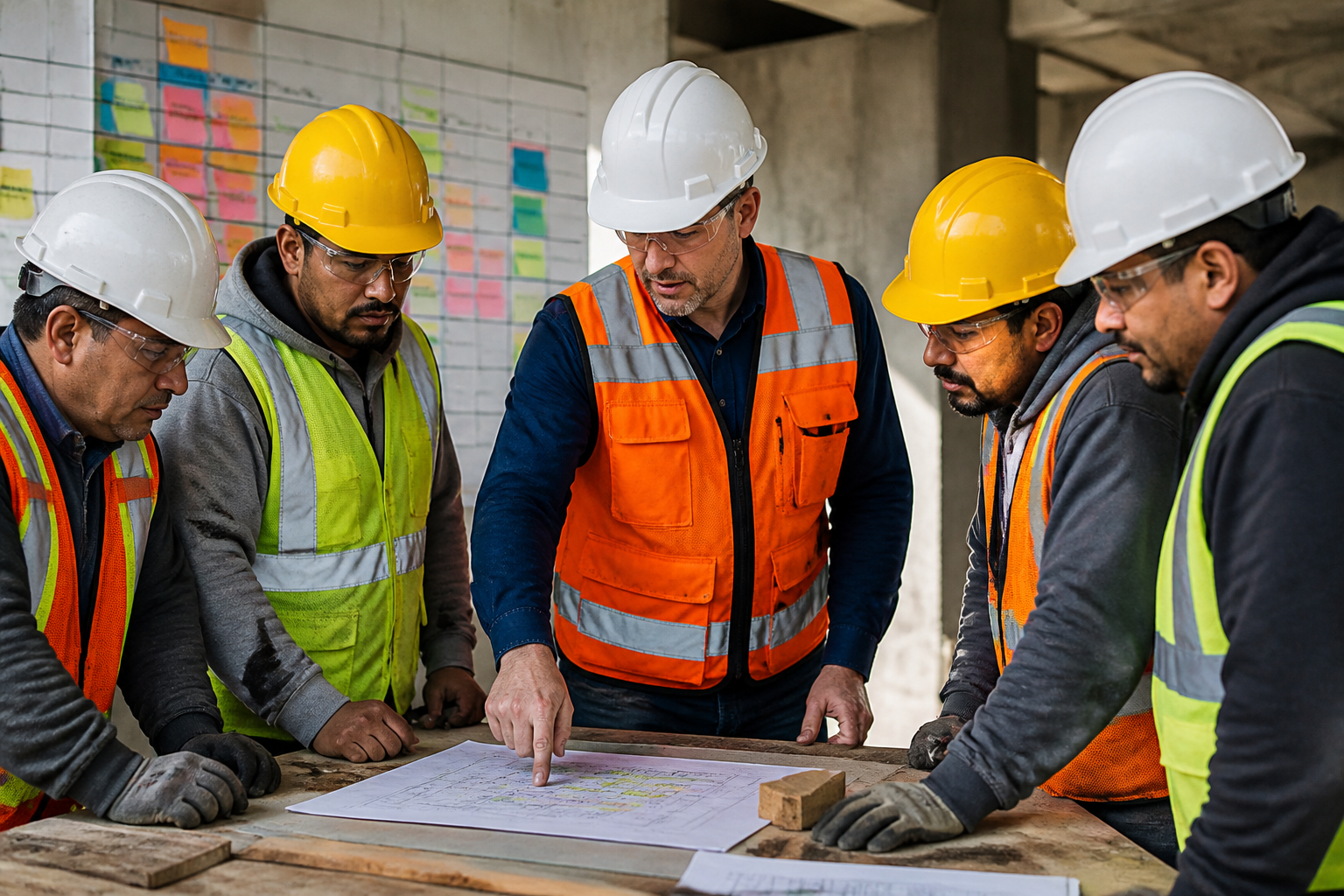
Implementing the last planner system multilingual construction teams rely on requires seamless communication across every trade. On modern commercial jobsites, general contractors depend on the Last Planner System (LPS) to stabilize workflow, reduce schedule variance, and ensure predictable completion dates. However, when trade foremen and craft workers have Limited English Proficiency (LEP), critical commitments can break down during weekly look-ahead meetings and daily stand-ups.
When Spanish-speaking or LEP subcontractors cannot fully express schedule constraints, identify prerequisite work, or commit to daily handoffs, the overall reliability of your pull plan suffers. Bridge this gap by adapting your Lean workflows to accommodate multilingual field teams and empowering foremen to actively participate in scheduling.
Visualizing Commitments on the Pull Planning Board
Traditional pull planning relies heavily on handwritten sticky notes detailing activities, durations, and trade handoffs. When LEP foremen participate, handwritten notes written quickly in English can lead to misunderstandings regarding scope or handoff timing.
Standardizing Visual Icons and Color Coding
Assign specific colors not just by subcontractor, but use standardized visual symbols for critical handoff conditions, such as curing concrete, inspection approvals, or crane availability. Replacing text-dense notes with clear visual indicators allows bilingual trade leads and LEP crew members to immediately grasp dependencies without translating long sentences on the board.
Implementing Dual-Language Sticky Notes
Utilize pre-printed, template-based sticky notes with standard Lean terminology printed in both English and Spanish (or the primary language of your trade crews). Fields such as "Prerequisites Needed" (Requisitos Necesarios), "Location" (Ubicación), and "Crew Size" (Tamaño de Cuadrilla) reduce language friction during fast-paced pull planning sessions.
Restructuring Daily Huddles for Multilingual Engagement
The 15-minute daily huddle is where the Last Planner System moves from strategy to execution. Adapting your last planner system multilingual construction process ensures that trade foremen active on the floor report progress, re-plan around daily disruptions, and declare constraints without hesitation.
Bipartite Huddle Facilitation
Structure daily stand-ups so that superintendents lead with concise, direct language while paired with a bilingual trade foreman or bilingual peer lead who can clarify points immediately. Avoid relying on unofficial, impromptu translations that dilute technical instructions or trade handoff requirements.
Key actions for effective multilingual daily huddles include:
- Pointing to physical locations: Use high-level floor plans or digital site maps displayed on site monitors to point out specific work zones rather than relying solely on room numbers or gridlines spoken aloud.
- Physical sign-offs: Require foremen to physically move their daily commitment tags from "In Progress" to "Complete" on the board, reinforcing accountability regardless of spoken language fluency.
- Verifying understanding with active demonstration: Instead of asking "Do you understand?", ask trade leads to point out where their crews will begin and end work for the day directly on the site map board.
Addressing Root Causes of Delays Without Language Friction
When commitments are missed, Lean construction demands a clear root-cause analysis to calculate Percent Plan Complete (PPC) accurately. If LEP foremen feel uncomfortable or struggle to articulate why work was halted, root causes get categorized vaguely as "trade delay" rather than identifying true site bottlenecks like material delivery delays or missing site access.
Simplifying Reason Codes
Create visual, standardized variance categories on your huddle board. Use simplified, bilingual charts for common reasons work fails to complete:
- Material/Equipment Not Delivered (Material/Equipo No Entregado)
- Preceding Trade Not Finished (Trabajo Previo No Terminado)
- Design Change/RFI Pending (Cambio de Diseño/RFI Pendiente)
- Weather/Site Conditions (Clima/Condiciones del Sitio)
Categorizing failures accurately ensures that jobsite leadership solves systemic workflow problems instead of inadvertently penalizing non-English speaking trade crews.
Jobsite Language Training Tailored to Lean Construction
Strengthening your last planner system multilingual construction approach by removing language barriers in daily huddles requires targeted, trade-specific language instruction. Generic English courses fail to teach the specialized vocabulary needed for pull planning meetings, constraint logs, and daily commitments.
Empowering Foremen and Crew Leaders
Providing customized workplace English training to high-potential Spanish-speaking workers turns craft specialists into confident Last Planners. Training should focus directly on project scheduling terms, handoff protocols, and safety-critical coordination phrases.
Similarly, equipping site superintendents and project engineers with basic operational Spanish related to schedule coordination builds mutual respect and speeds up daily problem-solving on the slab.
Driving Long-Term Reliability
A successful last planner system multilingual construction rollout depends on equipping crew leaders with the exact phrases required to negotiate workflow handoffs, flag unexpected site conditions early, and report accurate Daily PPC numbers without fear or communication friction.
Build a More Reliable Schedule with Targeted Language Training
When your tradespeople can clearly communicate commitments, identify constraints early, and participate fully in daily huddles, your jobsite achieves the true predictability Lean construction promises.
At New Heights Languages, we build customized workplace English and Spanish training programs specifically designed for construction contractors and trade crews. We teach your foremen and workers the exact vocabulary needed for Last Planner System integration, safety compliance, and site coordination.
Ready to eliminate language barriers on your jobsite visual management boards? [Book a free consultation with New Heights Languages today](/contact) to discuss customized language training tailored to your project schedule.
<!-- featured image alt: A construction superintendent running a daily huddle around a visual Last Planner board with Spanish-speaking trade foremen. -->