Machine Operator Maintenance Communication ESL Tips
By New Heights Languages ·
Bridge language gaps between operators and maintenance techs. Learn targeted workplace English strategies to report machinery anomalies fast.
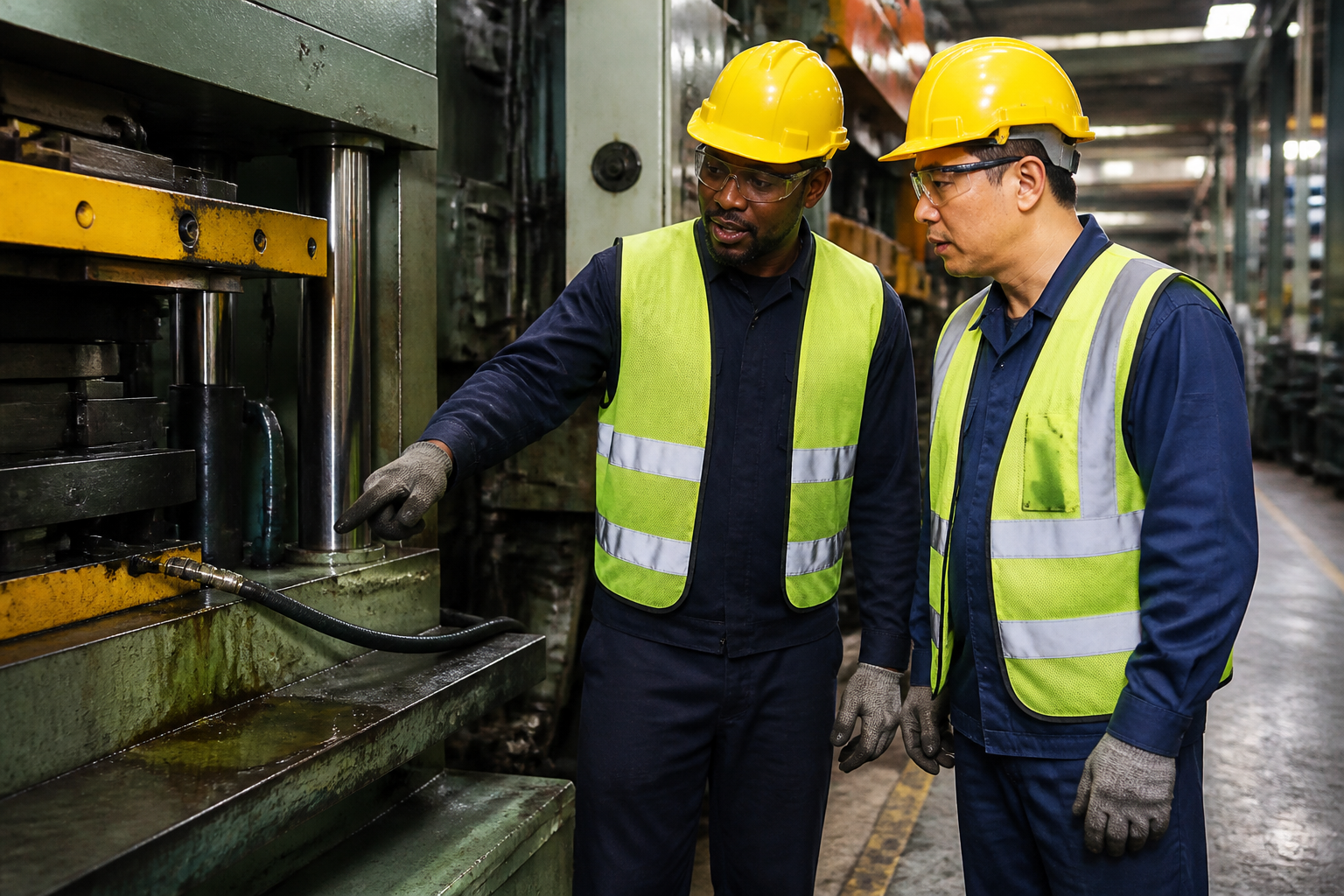
When a stamping press, CNC mill, or packaging conveyor starts making an unusual noise, your machine operators are the first line of defense. They feel the subtle vibration changes, catch the faint smell of overheated oil, and see the slight misalignment before a catastrophic mechanical failure occurs. However, if limited English proficient (LEP) operators lack the specialized technical vocabulary to describe what they are observing, critical diagnostic time is lost. Implementing targeted machine operator maintenance communication ESL training bridges this gap, allowing workers to report precise equipment anomalies before micro-stoppages turn into major plant downtime.
Too often, language barriers reduce detailed mechanical observations to generic phrases like "machine broken" or "it stopped." Maintenance technicians then arrive at the cell blind, spending 30 to 40 minutes troubleshooting an issue that an operator already observed 2 hours earlier. By equipping your workforce with specific sensory and mechanical terms, you streamline work orders and protect equipment lifespans.
The Cost of Vague Fault Descriptions on the Shop Floor
When non-native operators cannot precisely articulate what a machine is doing, maintenance teams face several operational challenges. Techs must start diagnostics from scratch, which inflates Mean Time to Repair (MTTR). In high-speed manufacturing environments, every extra minute of diagnostic investigation directly cuts into throughput targets.
Miscommunication also leads to incorrect replacement parts being pulled from inventory or unnecessary tear-downs of functioning subsystems. If an operator reports a "leak" because they lack the word for "condensation," a maintenance tech might bring hydraulic repair kits to a minor HVAC issue.
Furthermore, when workers feel self-conscious about their English skills, they may hesitate to escalate minor anomalies. They might wait until a component completely fails rather than reporting an early warning sign like a high-pitched squeal or a sluggish cylinder stroke. Improving machine operator maintenance communication ESL skills empowers workers to speak up early without fear of being misunderstood.
Essential Sensory Vocabulary for Equipment Anomalies
To describe machine behavior accurately, operators need functional vocabulary categorized by sensory input and mechanical movement. Standard ESL programs teach general terms like "loud" or "hot," but shop floor communication demands exact descriptors.
Focus your training programs on four core categories of anomaly terms:
- Aural (Sound) Descriptors: Buzzing, grinding, squealing, knocking, chattering, clicking, hissing, and rattling. Operators should be able to distinguish between a continuous hiss (air leak) and a rhythmic knock (bearing wear).
- Visual Descriptors: Frayed, misaligned, clogged, weeping, pooling, cracked, bent, loose, and smoke. Operators must be able to specify where the visual issue is occurring.
- Tactile (Touch/Sensation) Descriptors: Excessive heat, rough movement, abnormal vibration, binding, catching, and sluggishness.
- Olfactory (Smell) Descriptors: Burning electrical, scorched oil, sweet (coolant), and pungent chemical odors.
Teaching workers to pair these descriptors with specific component names gives maintenance technicians the exact context needed to bring the right tools to the machine immediately.
Standardizing Visual and Phrase-Based Diagnostic Reporting
Building language confidence requires structured templates. Give non-native operators clear phrase structures they can use verbally or write on maintenance tag systems.
Simple Escalation Formulas
Teach workers a simple three-part reporting formula: Location + Action/Symptom + Timing.
For example:
- "The main hydraulic pump (location) is making a grinding noise (symptom) during the press stroke (timing)."
- "Cylinder 3 (location) feels very hot (symptom) after 10 minutes of running (timing)."
- "The discharge belt (location) is catching (symptom) every time it restarts (timing)."
Using structured templates reduces the cognitive load on non-native speakers, helping them form clear sentences under operational stress.
Multilingual Maintenance Tagging Systems
Pairing verbal instruction with visual tag cards accelerates learning. Implement physical work order tags that feature common anomaly terms in English paired with clear iconography. When operators tag out a machine or submit a digital maintenance request, they can check off the symptom while practicing the English term with their team lead.
Bridging the Gap Between Operators and Maintenance Techs
Effective communication requires effort from both sides of the repair request. While operators build their vocabulary, maintenance technicians and supervisors must adapt their listening and response habits.
Integrating machine operator maintenance communication ESL concepts into daily huddles helps normalize technical dialogue across shifts. Encourage maintenance techs to walk through their diagnostic process with operators after completing a repair. When a tech points to a worn shaft and says, "This bearing was binding because of low lubrication," they reinforce the exact vocabulary taught in language training.
Cross-departmental patience is vital. Techs should avoid using complex jargon or rapid-fire acronyms when asking clarifying questions. Closed-loop communication—such as asking the operator to point to the issue or repeat the key details—ensures everyone agrees on the problem before work begins.
Tailoring Workplace Language Training to Your Equipment
Off-the-shelf language software cannot teach your employees the specific terms used on your production lines. A plant operating blow-molding equipment requires entirely different terminology than a facility running CNC lathes or automated packaging cells.
Customized, on-site or instructor-led workplace English programs focus directly on your facility's specific machinery, safety procedures, and work order forms. When customized machine operator maintenance communication ESL training uses your plant's real equipment photos, control panel labels, and maintenance forms, workers retain vocabulary faster and apply it immediately on their next shift.
Investing in job-specific English training transforms limited English operators into active observers who protect your capital equipment, streamline maintenance workflows, and keep production lines running safely.
Optimize Maintenance Communication on Your Shop Floor
Help your limited English operators communicate machine anomalies with clarity and confidence. New Heights Languages designs customized workplace English courses tailored to your plant's equipment, maintenance processes, and operational goals.
[Book a free consultation today](/contact) to discuss how targeted language training can reduce downtime and improve maintenance efficiency on your shop floor.
<!-- featured image alt: A machine operator pointing out a hydraulic leak on a stamping press to a maintenance technician in a manufacturing plant. -->