Scaffolding Safety: Spanish Construction Crew Guide
By New Heights Languages ·
Verify scaffolding erection and daily inspections with Spanish-speaking masonry crews. Learn key safety vocabulary and jobsite verification protocols.
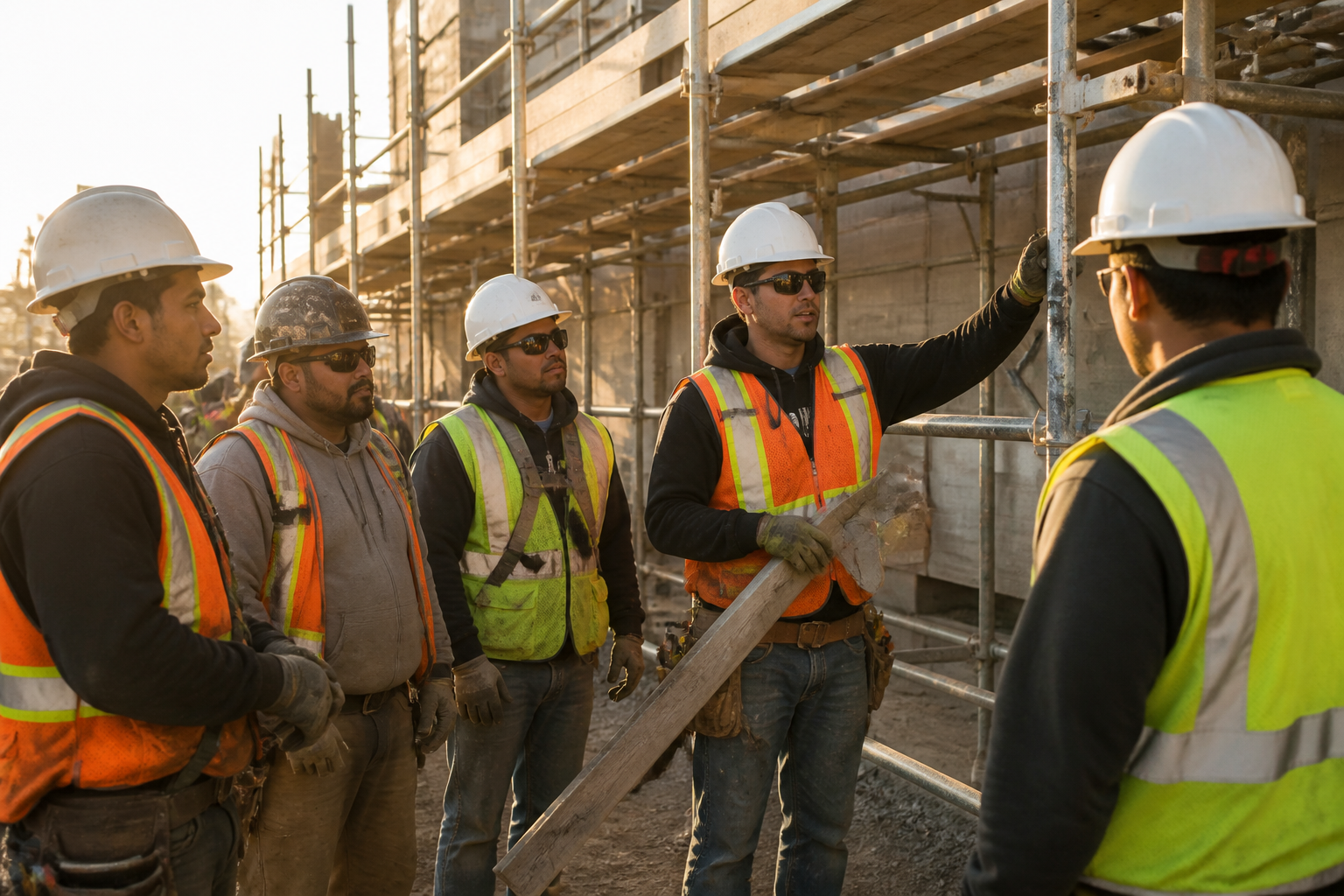
Masonry work requires some of the heaviest material loads supported by temporary structures on a commercial construction site. When building multi-story brick or block walls, field supervisors must verify that frames, mudsills, cross-braces, and tie-ins are set up to strict OSHA standards. Maintaining scaffolding safety spanish construction crew members understand requires moving past generic safety handbooks and implementing targeted, jobsite-specific language protocols.
Language barriers during frame assembly or pre-shift inspections directly impact site integrity. If a masonry crew cannot clearly explain a structural defect or understand an inspector's corrective action, minor oversights can escalate into catastrophic collapses.
High-Load Masonry Scaffolding Risks and Communication Gaps
Masonry crews do not just work at heights; they work at heights while loading thousands of pounds of concrete block, mortar tubs, and stone veneer onto work platforms. The physical demands of the trade make proper scaffold assembly critical to crew survival.
Heavy Materials and Structural Integrity
Unlike light-duty painter frames, masonry scaffolds must support heavy-duty point loads. If mudsills are unlevel or base plates sit on unstable soil, the added weight of wet mortar and pallets of brick accelerates structural shift. When supervisors attempt to verify soil stability or load capacities using only basic gestures, critical safety factors get lost in translation.
The Danger of Assumptions During Erection
Erection and dismantling are the most hazardous phases of scaffolding operations. Spanish-speaking workers may possess years of field experience in their home countries, but construction standards, component terminology, and safety regulations often differ. Assuming a worker understands a term like "outrigger extension" or "gravity pin" without verifying comprehension creates immediate failure points.
Essential Scaffolding Terminology Beyond Basic Spanish
Standard English-as-a-Second-Language (ESL) courses teach general vocabulary that fails on a active masonry jobsite. To establish rigorous scaffolding safety spanish construction crew supervisors can rely on, workers and foremen must master specific technical terms used during erection and inspection.
Key structural components and concepts that require clear bilingual alignment include:
- Base Plates and Mudsills (Placas de base y soleras): Structural footings that distribute point loads evenly over ground surfaces.
- Cross-Braces and Frame Pins (Crucetas y pasadores de seguridad): Interlocking components that maintain lateral stability and prevent frame racking.
- Tie-Ins and Anchors (Anclajes y amarres): Mechanical attachments securing the scaffold tower directly to the structural building wall.
- Outriggers and Cantilever Brackets (Voladizos y soportes adicionales): Extended platforms designed to widen the working surface for block placement.
- Plank Grade and Overhang (Calidad de tablones y vuelo de tablas): Scaffold-grade lumber standards, maximum span limits, and minimum 6-to-12-inch overhang rules.
- Max Intended Load (Capacidad de carga máxima): The combined weight of masons, materials, and tools allocated per bay.
Field training should focus on linking these English terms to their physical counterparts on site so workers can report worn or damaged hardware instantly.
Verifying Tagging Systems and Daily Inspections
OSHA requires a competent person to inspect scaffolding before every work shift. However, daily safety depends heavily on the eyes and ears of the masonry crew working on the frames throughout the day.
Moving Past Silent Nods on Green and Red Tags
A green tag indicates a safe, fully inspected scaffold, while a red tag halts all work. Too often, limited-English proficient (LEP) workers see a yellow caution tag or a modified red tag and continue loading materials because they cannot read the specific restriction notes written on the tag.
Supervisors must train crews to read inspection tags and express exact status conditions in English. A worker should be able to state clearly, "This bay needs a middle rail," or "The tie-in on floor three is loose," rather than offering a silent nod when asked if the setup is safe.
Two-Way Hazard Reporting Before Ascending
Before any block is hoisted, the competent person and the masonry crew lead should conduct a verbal walk-through. Teaching workers how to articulate specific mechanical hazards—such as split planks, missing lock pins, or unattached guardrails—ensures that potential failures are flagged before loading begins.
Conducting Effective Site Audits with Spanish-Speaking Crews
Auditing scaffolding safety spanish construction crew performance requires interactive, field-based verification rather than passive classroom lectures. Inspection audits must test both physical setup and verbal comprehension.
Verifying Tie-Ins and Outrigger Placement
During a routine walk-through, ask the crew leader and platform workers to point out each tie-in point and state its vertical and horizontal spacing. If workers cannot explain why an anchor was placed at a specific tie-in ratio, conduct immediate retraining on load resistance and wall attachment standards.
Practical Demonstration Over Written Sign-offs
Written sign-off sheets prove that a worker signed a document, not that they understand scaffold safety rules. Replace passive sign-offs with practical demonstrations. Have workers physically inspect a frame, identify deliberately staged hazards (such as an unpinned frame or an improper mudsill), and verbalize the correction in English.
This hands-on verification builds true operational competence, protects equipment, and keeps your masonry operations fully compliant during federal or state safety inspections.
Bridge the Language Gap on Your Jobsite
Building a culture of safety on commercial jobsites requires actionable language instruction tailored directly to your trades. Generic language apps do not teach masonry crews how to inspect mudsills, verify load limits, or report structural scaffold defects.
New Heights Languages provides practical, industry-tailored language training designed specifically for construction crews and field supervisors. Help your team communicate clearly, eliminate safety risks, and keep projects moving on schedule.
[Book a free consultation with New Heights Languages today](/contact) to discuss customized onsite or virtual language programs for your workforce.
<!-- featured image alt: A masonry crew inspecting metal scaffolding frames and wooden planks on a commercial construction jobsite. -->