Standardized Work ESL Operators: Plant Guide
By New Heights Languages ·
Involve ESL operators in standardized work creation to eliminate process drift, improve Lean takt times, and build accurate shop floor instructions.
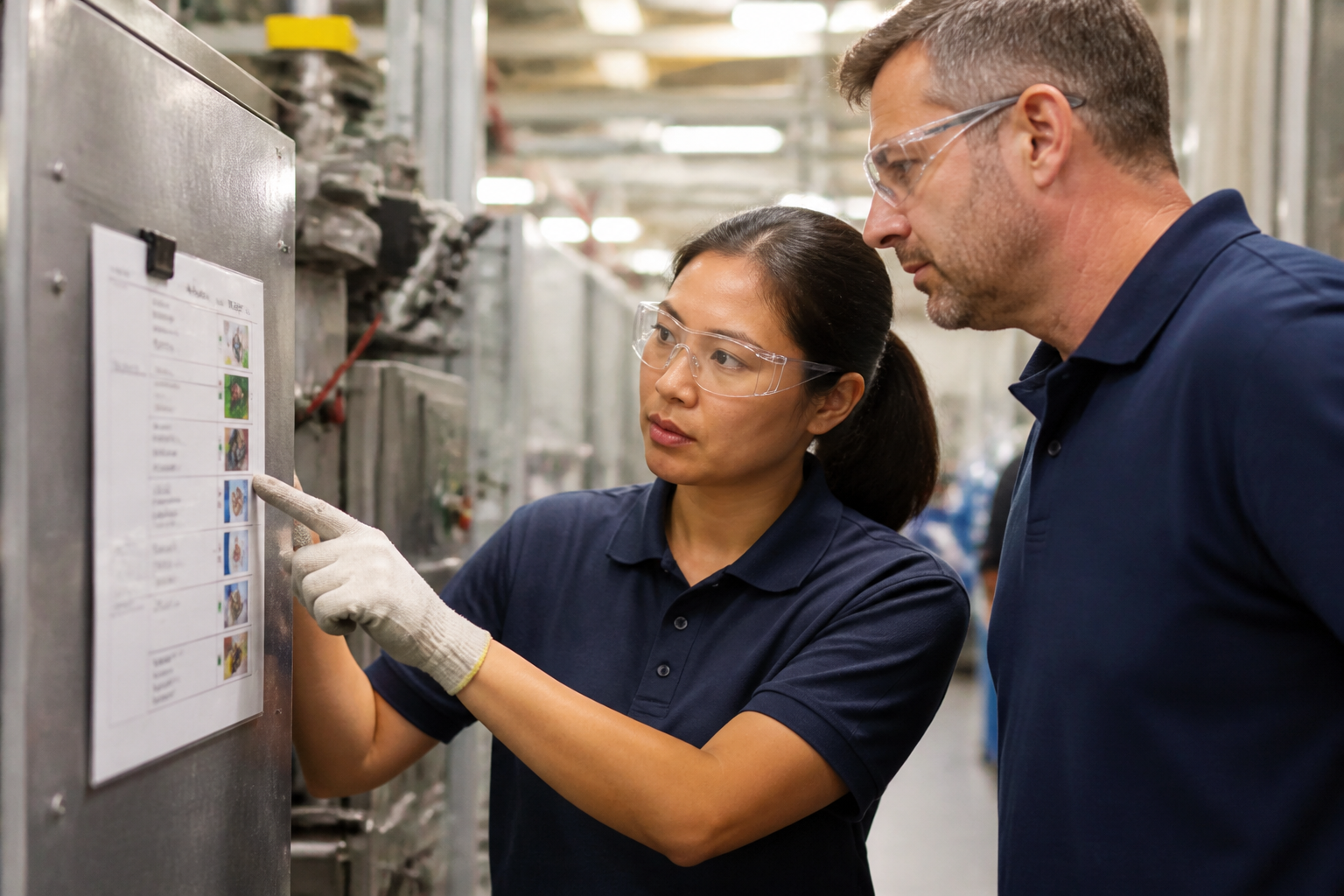
When industrial engineers draft Standard Operating Sheets (SOS) in a conference room, plant leadership rarely gets the results they expected. The documentation looks pristine, but cycle times slip, scrap rates hold steady, and operators revert to their own unwritten methods within a week. Building durable standardized work ESL operators can execute requires capturing reality at the gemba, not documenting theory from an engineering desk.
In many U.S. processing and assembly plants, frontline lines run smoothly because experienced non-native English speakers have developed subtle workarounds to manage machine quirks, raw material variations, and awkward changeovers. When these employees are excluded from the documentation process due to language gaps, your continuous improvement team ends up standardizing the wrong sequence. Involving these crew members directly in drafting and verifying work instructions transforms Lean initiatives from a top-down compliance exercise into an accurate, operational baseline.
The Flaw of Top-Down Documentation in Multilingual Plants
When continuous improvement managers write process sequences without direct operational input, they rely on mechanical cycles and theoretical motion economy. They assume an operator picks a sub-assembly, places it in a jig, drives four fasteners, and hits the cycle-start palm buttons.
What actually happens on the floor is often very different. The operator might wipe metal shavings from the locator pin first, tap the part twice to seat an inconsistent casting, and check a visual witness mark before touching the torque tool. These unrecorded micro-actions represent tribal knowledge developed over hundreds of hours.
If the process engineer cannot converse effectively with the employee running the station, these critical details are lost. When engineers ask, "Does this sheet match what you do?" workers who lack workplace English confidence often nod, say yes, and return to their stations. The resulting documentation looks compliant on an ISO audit form, but it fails to stabilize takt time or train new hires properly.
Conducting Gemba Sequencing with Frontline Crews
To capture true work sequences, your engineering and supervisory staff must engage operators directly at their workstations. Documenting standardized work ESL operators rely on every shift requires moving past yes-or-no questions toward physical, collaborative observation.
Deploy these specific field practices during your time studies and sequence mapping:
- Sequence breaking at the station: Stand with the operator through five consecutive cycles. Break the work element into observable steps using direct, physical observation rather than abstract terminology.
- Operator-led step definition: Ask the worker to point to the start point and finish point of each micro-step. Use clear, direct English: "Where does step one end? When the tool stops, or when you place the tool back in the holster?"
- Highlight the 'why' behind deviations: If an employee executes an unexpected motion, do not correct them immediately. Ask: "Why do you wipe the sensor here?" You will often uncover an unresolved maintenance issue or a variable raw material spec that the engineering department never knew existed.
- Physical verification runs: Have the worker walk a peer through the drafted steps while pointing at the visual work instruction. Observing this peer-to-peer interaction immediately reveals whether the sequence is natural, clear, and repeatable.
Structuring Clear Standard Operating Sheets (SOS)
Standard work documents must be functional references, not dense legal manuals. When your plant floor includes limited English proficient (LEP) workers, the layout of the sheet dictates whether it will be used or ignored.
Every operational step must be stripped down to three distinct components: work sequence, cycle time, and key safety or quality points. Technical jargon must be replaced with consistent plant-floor terminology.
Work Elements and Verbs
Use active, imperative verbs. Words like insert, align, torque, slide, verify, and release provide unmistakable physical direction. Avoid vague passive phrases like "ensure proper orientation is achieved." Instead, write: "Align notch with green pin."
Critical Quality Landmarks
Quality checkpoints must focus on sensory verification. If a torque sequence requires a specific feel or auditory confirmation, specify it clearly: "Listen for two clicks" or "Check for flush surface." High-resolution, tight-angle photos showing the correct result next to a photo with a red "X" over the common error eliminate ambiguity across all language backgrounds.
Cycle and Takt Boundaries
State the target time clearly for each discrete element. When employees understand the exact target seconds for each sub-step rather than just a total shift quota, they can spot where bottlenecks occur and tell supervisors where the line is fighting them.
Building Language Confidence for Kaizen and Audits
Standardized work is never permanent; it serves as the baseline for continuous improvement. If your employees cannot communicate friction in their daily routines, your plant cannot eliminate waste.
When companies deliver targeted workplace English training focused on shop floor operations, workers gain the vocabulary required to flag process issues. Instead of staying silent when a parts vendor delivers misaligned brackets, an operator can say: "Part sits loose in the fixture. Adds five seconds every cycle."
Similarly, supervisors conducting standard work audits can stop acting like industrial police. When managers use straightforward language and workers understand the intent behind process audits, reviews become collaborative troubleshooting sessions:
- "Is this sequence harder today?"
- "Show me where you lose time on this station."
- "Does the tool reach without twisting your wrist?"
This level of communication makes implementing standardized work ESL operators can update and defend realistic for high-turnover, high-velocity production environments.
Close Process Gaps by Empowering Your Frontline Crews
Lean manufacturing fails when process documentation lives in an engineering silo. You cannot stabilize cycle times, eliminate rework, or scale operations without the active, vocal participation of the employees running your machines.
New Heights Languages designs practical, industry-specific English and Spanish training programs for manufacturing facilities. We equip frontline operators, team leads, and supervisors with the exact language skills needed to document processes, flag bottlenecks, and sustain Lean systems.
To evaluate language gaps on your plant floor and discuss customized on-site or remote training solutions, [schedule a consultation with our team](/contact).
<!-- featured image alt: A manufacturing supervisor and an ESL line operator reviewing a visual standardized work sheet clipped to a machine station. -->