Trenching Safety Spanish Translation & Shoring
By New Heights Languages ·
Verify excavation shoring protocols with Spanish-speaking crews. Learn site-specific terms, competent person checks, and actionable trench safety.
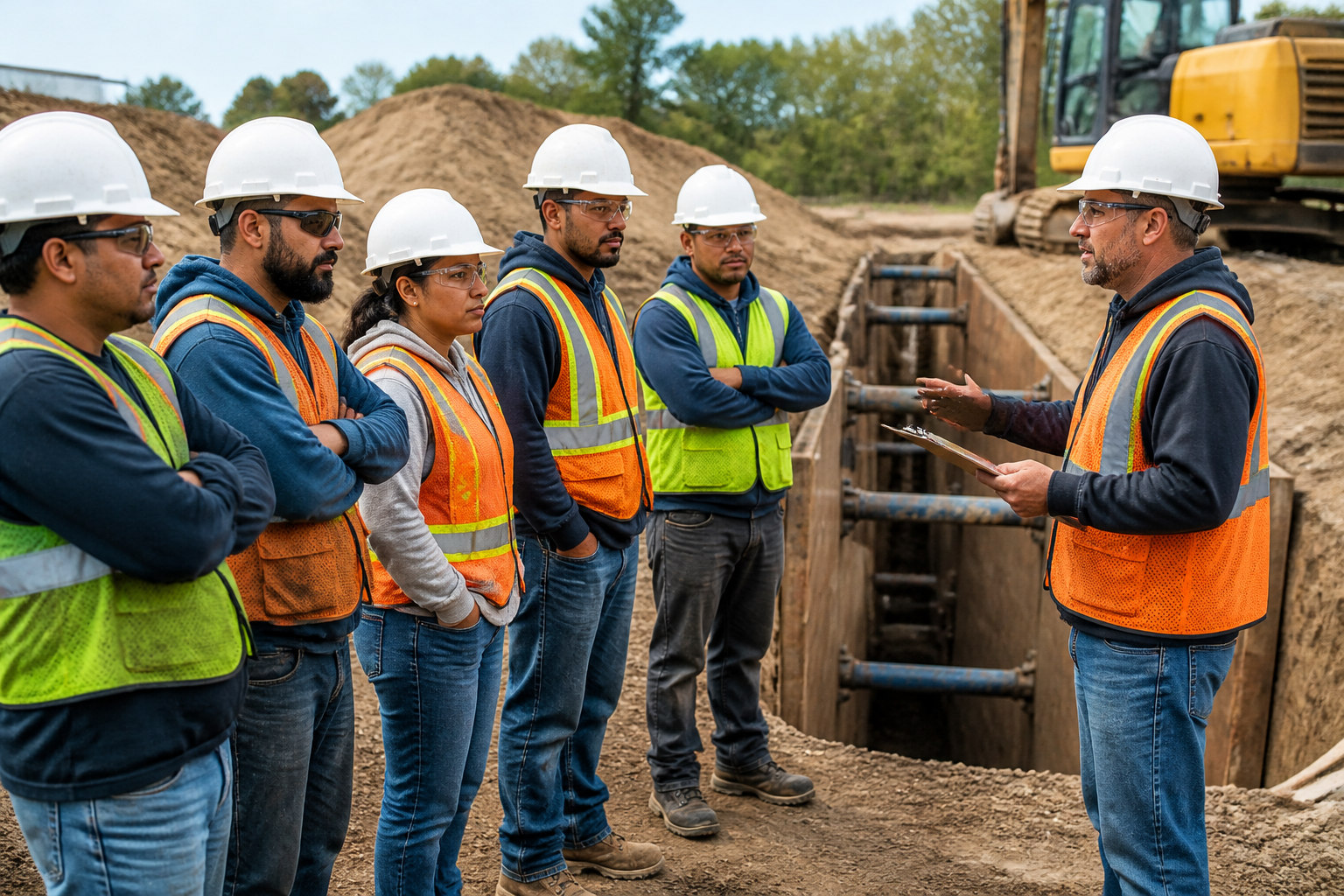
Excavation work carries one of the highest fatality rates in utility and site preparation construction. A trench collapse occurs in seconds, burying workers under thousands of pounds of unstable soil. While safety managers deploy trench boxes, hydraulic shoring, and sloping systems, protective equipment only protects lives if crews fully understand soil mechanics, benching limits, and emergency egress protocols. For jobsites relying on Hispanic craft workers, accurate trenching safety Spanish translation and site-level language strategies are essential to ensure shoring protocols are executed correctly every day.
When language barriers exist on an excavation site, standard safety briefings often fall short. Workers may nod out of courtesy during morning huddles without fully grasping the nuances of protective system installation or environmental hazard shifts. Protecting your crew requires bridging the gap between mandatory OSHA subpart P standards and real-world field communication.
The Failure Point in Standard Trenching Briefings
On a busy jobsite, safety instructions are frequently compressed into quick verbal updates before heavy machinery begins moving. A supervisor might remind the crew to stay inside the trench shield, keep the spoil pile back, and check the hydraulic pressure on aluminum shoring cylinders. If Spanish-speaking workers only understand part of that message, critical safety margins erode.
For example, a worker might understand the instruction to stay within the protected area but miss the warning that a soil face has begun to fissurate or that rain overnight degraded a Type B soil down to Type C. If they do not know how to communicate signs of impending cave-ins back to the competent person, dangerous conditions go unreported.
Relying on informal worker-to-worker translation can also distort technical safety protocols. A bilingual laborer asked to translate complex shoring instructions on the fly might lack the specific Spanish terminology for protective system components, leading to misinterpretations about pin placements, shore spacing, or trench box stack limits.
Essential Trenching and Shoring Terms in Spanish
To establish clear communication on the jobsite, supervisors and workers must share a precise technical vocabulary. Generic terms do not suffice when describing specialized trenching hardware and excavation procedures. Field leaders should integrate these key terms into daily operations:
- Trench Shield / Trench Box: Caja de protección or Escudo de zanja
- Hydraulic Shoring: Apuntalamiento hidráulico
- Sloping / Benching: Inclinación (Talud) / Escalonamiento
- Cave-in / Soil Collapse: Derrumbe or Desprendimiento de tierra
- Spoil Pile: Pila de material excavado or Pila de escombros
- Egress / Access Ladder: Escalera de acceso y salida
- Competent Person: Persona competente
- Soil Type (A, B, C): Tipo de suelo (A, B, C)
- Struts / Crossmembers: Travesaños or Puntales
Using correct operational phrases ensures that when a supervisor issues an instruction about adjusting a hydraulic shore or retreating from an unstable bench, the crew acts instantly without hesitation or confusion.
Why Generic Trenching Safety Spanish Translation Falls Short
Automated mobile translation tools and direct dictionary translations often fail on excavation sites because they miss technical context. Translating "spoil pile" literally through automated software can result in phrases like pila de despojos, which translates closer to "pile of animal remains" rather than excavated dirt. Such errors cause confusion and undermine crew confidence in safety instructions.
Using site-accurate trenching safety Spanish translation ensures that safety standards are communicated in practical construction Spanish that workers actually use on the job. Beyond written translation, supervisors need clear methods to verify that workers truly comprehend protective protocols.
Instead of asking close-ended questions like "¿Entienden?" (Do you understand?), supervisors should use open-ended, action-based verification. Have workers explain back in their own words—or physically demonstrate—how far back the spoil pile must sit from the trench edge or where the ladder must be placed relative to their work area.
Operationalizing Shoring Protocols on Spanish-Speaking Jobsites
Systematic verification of excavation protocols requires integrating structured communication into every stage of the trenching process. Supervisors can strengthen jobsite compliance through three key operational practices.
1. Daily Soil Evaluation and Shoring Reviews
Before workers enter any excavation deeper than four feet, the competent person inspects the soil and protective equipment. Use this moment to review soil conditions directly with the crew. Explain why specific shoring is required based on whether the soil is cohesive or granular, and verify that workers recognize visual signs of soil distress such as tension cracks or bulging at the trench base.
2. Verifying Emergency Egress Placement
OSHA regulations mandate that trenches four feet deep or greater have a means of egress, such as a ladder or ramp, located within 25 lateral feet of all workers. During pre-shift briefings, require crew members to locate and confirm their clear exit path. Workers must have the language tools to immediately alert operators if an exit pathway becomes obstructed by materials or pipe sections.
3. Monitoring Environmental and Traffic Hazards
Excavations are dynamic environments. Heavy equipment movement causes ground vibrations that compromise wall stability, while water accumulation drastically increases cave-in risks. Crews must be equipped to speak up immediately if they notice water pooling at the trench floor or heavy haul trucks driving too close to the edge.
Building Lasting Site-Level Language Skills
Generic, off-the-shelf safety videos rarely change daily habits on an active excavation site. Long-term risk reduction requires targeted language training tailored to your company's specific jobsite operations, soil conditions, and trenching equipment.
By providing your supervisors with functional construction Spanish and offering your Spanish-speaking workers job-specific workplace English, you build a cohesive environment where safety standards are understood and enforced by everyone on site. Incorporating targeted trenching safety Spanish translation into your ongoing site training ensures your crews remain safe, compliant, and productive.
Ready to eliminate language barriers on your excavation and construction sites? [Book a free consultation with New Heights Languages](/contact) to learn how our customized, site-specific language programs keep your crews safe and compliant.
<!-- featured image alt: A construction foreman holding a clipboard and explaining trench box safety protocols to Spanish-speaking construction workers near an excavation site. -->