5 Beginner Spanish Grammar Mistakes to Fix
By New Heights Languages ·
Learn how to fix common beginner spanish grammar mistakes made by supervisors on manufacturing and construction job sites.
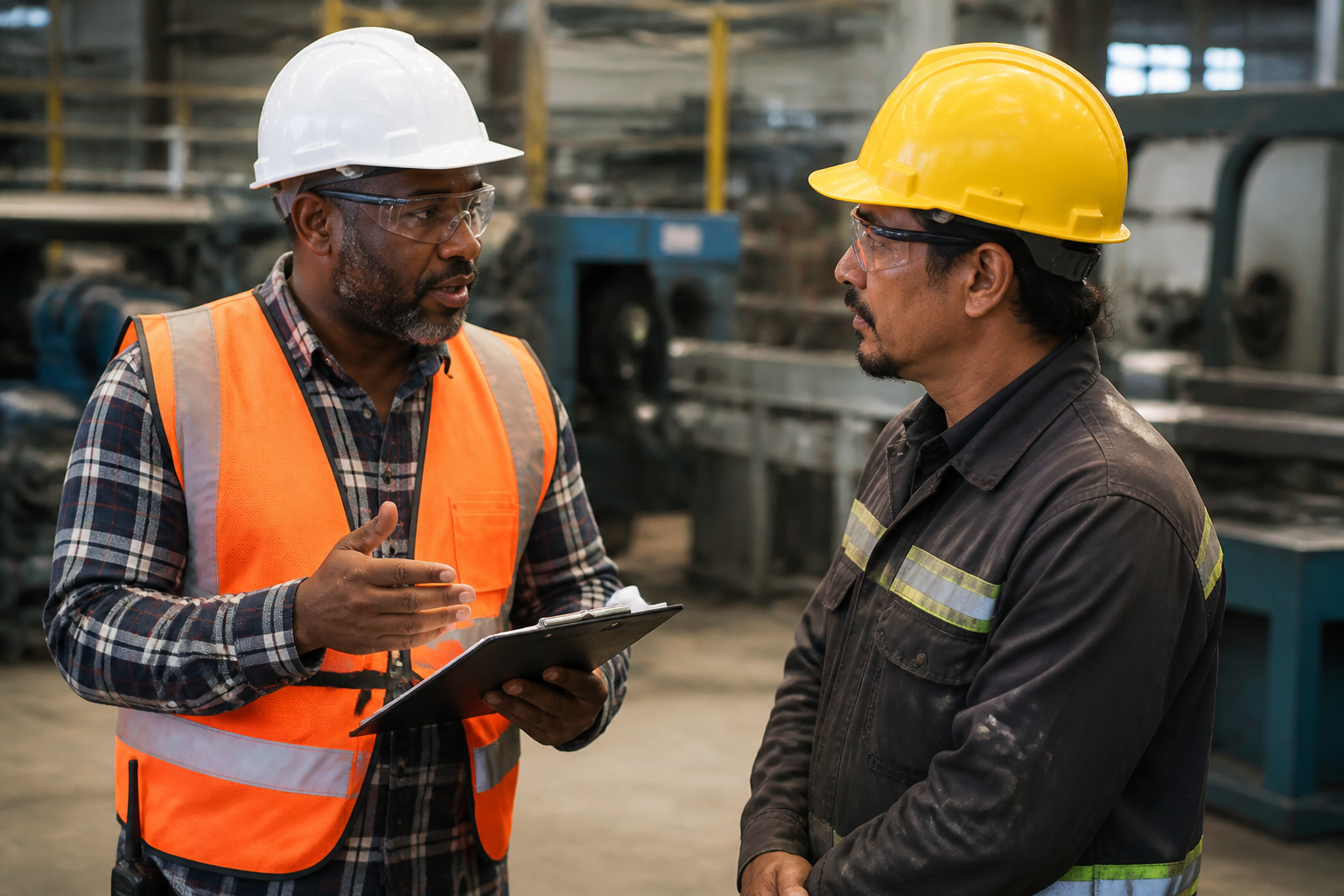
When English-speaking supervisors start learning Spanish to communicate better on the shop floor or job site, making beginner spanish grammar mistakes is a natural part of the process. In fast-paced industrial environments, clear communication is tied directly to safety, quality control, and worker productivity. Minor misunderstandings can lead to delayed shipments, incorrect assemblies, or safety hazards.
Addressing these beginner spanish grammar mistakes early prevents bad habits from hardening into permanent speech patterns. Supervisors do not need to speak perfect literary Spanish to lead effectively, but mastering core grammatical structures builds trust and ensures essential directives are understood clearly by every crew member.
Here are five of the most frequent errors native English speakers make when speaking workplace Spanish, along with practical strategies to correct them immediately.
1. Confusing Por and Para in Work Orders
One of the most frequent stumbles for English speakers is choosing between por and para. Both words translate to 'for' in English, but using the wrong one alters the meaning of a workplace instruction.
Why this happens
English relies heavily on context to define 'for,' whereas Spanish uses separate prepositions to distinguish between reasons, deadlines, destinations, and duration.
How to fix it on the job site
Remember these core rules for operational contexts:
- Use para for deadlines, recipients, and final goals (e.g., Necesito este reporte para el viernes — 'I need this report by Friday').
- Use por for duration of time, exchange, or reason (e.g., Trabajamos por cuatro horas — 'We worked for four hours').
When scheduling shifts or setting completion goals, default to para for target times and por for elapsed durations.
2. Misusing Ser and Estar for Equipment and Safety Conditions
English uses a single verb—'to be'—where Spanish uses two distinct verbs: ser and estar. Mixing these up can create confusion regarding whether an equipment state is permanent or temporary.
Temporary vs. permanent states in manufacturing
Using ser describes essential characteristics, while estar describes temporary states, physical locations, or current conditions.
- La máquina es vieja. (The machine is old — a permanent trait.)
- La máquina está rota. (The machine is broken — a temporary condition.)
Quick rule for supervisors
If you are describing safety conditions, operational readiness, or employee locations, always use estar. For example, El área está limpia (The area is clean) signals that maintenance was completed, whereas El área es limpia sounds grammatically awkward to your team. Avoiding these common beginner spanish grammar mistakes ensures your safety directives are precise and unambiguous.
3. Ignoring Gender Agreement with Tools, Parts, and Safety Gear
Every Spanish noun is assigned a grammatical gender (masculine or feminine). Modifiers—such as adjectives and articles—must agree in gender and number with the noun they modify.
Masculine and feminine nouns in construction
Supervisors often make the mistake of using masculine articles (el or un) for all vocabulary words or forgetting to adjust adjective endings.
- El casco rojo (The red hard hat - masculine)
- La herramienta nueva (The new tool - feminine)
- La escalera alta (The tall ladder - feminine)
Common workplace nouns reference
Here is a quick reference for job site vocabulary:
- Masculine: El martillo (hammer), el arnés (harness), el montacargas (forklift), el taladro (drill)
- Feminine: La sierra (saw), la cinta (tape), la caja (box), la planta (facility)
To fix this error, always learn nouns with their accompanying article (el or la) rather than memorizing isolated vocabulary words.
4. Translating Direct Commands Literally from English
When giving directives, English speakers often default to word-for-word translations. Saying 'I need you to clean this' by literally translating every English word can sound overly rigid or grammatically awkward in Spanish.
Using polite imperatives vs. literal translations
In English, managers frequently rely on phrases like 'I need you to...' or 'Can you...'. In Spanish workplace culture, direct verbs paired with polite phrasing work far better.
Essential imperative patterns for managers
Instead of translating word-for-word (Yo necesito que tú limpies), try using clear, direct workplace phrasing:
- Por favor, limpia la estación de trabajo. (Please clean the workstation.)
- Hay que revisar el inventario. (We/you need to check the inventory.)
Using the structure hay que + infinitive verb is an effective way to communicate tasks clearly without worrying about complex verb conjugations, helping supervisors fix beginner spanish grammar mistakes while keeping directives neutral and professional.
5. Misplacing Adjectives in Technical Descriptions
In English, adjectives almost always precede the noun ('red button', 'protective glasses'). In Spanish, the adjective typically follows the noun.
Noun-first rules in Spanish
When describing parts, defects, or safety equipment, putting the adjective first sounds unnatural and can occasionally obscure meaning in written logs or verbal instructions.
- Incorrect: El rojo botón
- Correct: El botón rojo
- Incorrect: El grande montacargas
- Correct: El montacargas grande
Technical description examples
- Guantes de seguridad (Safety gloves)
- Tubo de plástico (Plastic pipe)
- Línea principal (Main line)
Remember the standard sequence: name the physical object first, then describe its features, color, or condition.
Build a More Effective Workplace with Tailored Language Training
Correcting grammar errors is not just an academic exercise—it directly impacts job site safety, operational efficiency, and team morale. When managers take time to speak clear, accurate Spanish, workers appreciate the effort and respect the clarity of leadership.
At New Heights Languages, we deliver customized, site-specific workplace Spanish training for supervisors and managers in manufacturing and construction. We focus on real workplace vocabulary, job site scenarios, and practical grammar that gets results without wasting time on non-essential topics.
Ready to improve communication and safety across your operational teams? [Book a free consultation](/contact) with our team today to discuss customized language programs for your workforce.
<!-- featured image alt: A construction supervisor talking with a crew member on a job site while holding a clipboard. -->