Heavy Equipment Spotter Language Protocols
By New Heights Languages ·
Standardize heavy equipment spotter language protocols to prevent blind-spot collisions and protect ground workers on tight urban construction sites.
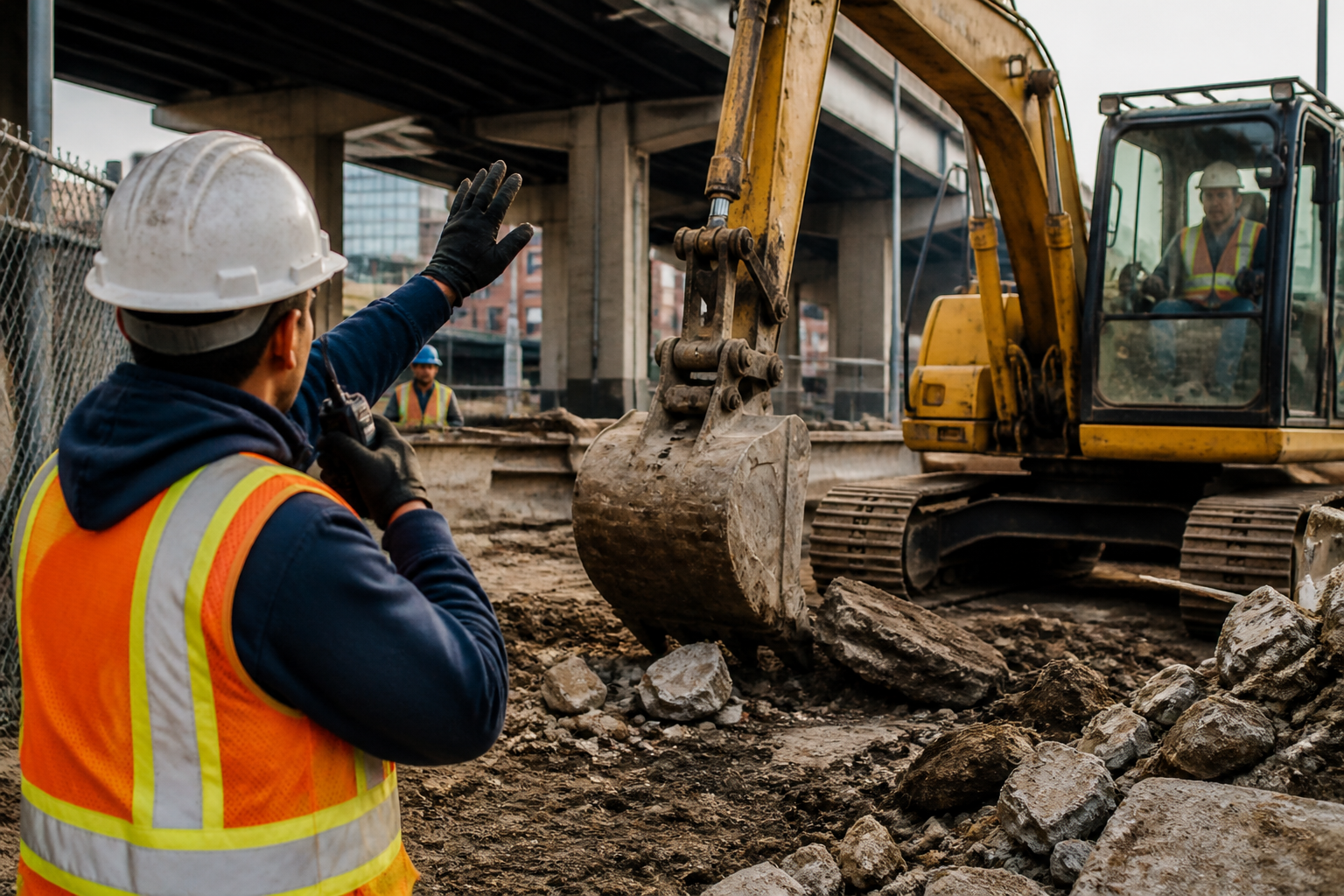
Urban construction sites leave virtually no margin for error. When a 30-ton excavator swings its counterweight or an articulated dump truck reverses down an alleyway bordered by pedestrian barricades, the equipment operator is often operating with severe blind spots. In these tight quarters, the dedicated ground spotter is the operator's eyes and ears. However, when an English-speaking operator and a Spanish-speaking spotter rely on improvised gestures or half-understood radio calls, disaster is only seconds away. Establishing standardized heavy equipment spotter language protocols bridges this operational gap, ensuring clear, immediate coordination before tracks roll or booms swing.
Miscommunication on a jobsite is not a minor inconvenience; it is a direct precursor to struck-by injuries, utility strikes, and structural collisions. By formalizing the terms, callouts, and radio procedures used between operators and ground crews, contractors can turn chaotic blind spots into tightly controlled zones.
The High-Density Danger Zone of Urban Earthwork
Urban infill projects present unique spatial hazards rarely found on open greenfield sites. Excavation equipment must maneuver within inches of shoring walls, overhead utility lines, and site perimeter fencing. At the same time, ambient street traffic, jackhammers, and generators create an acoustic environment where shouting is completely useless.
Operators inside pressurized, sound-dampened cabs rely heavily on their side mirrors, backup cameras, and spotters. Yet mirrors collect dust, cameras have focal limitations, and direct line of sight is frequently blocked by the machine's own boom or engine housing.
When a spotter on the ground notices an ironworker walking behind an oscillating counterweight, a hesitant or ambiguous warning can lead to tragedy. If the spotter yells a phrase the operator does not immediately process, reaction times drop. A split-second delay in braking or swinging can mean the difference between a near-miss and a fatal incident.
Establishing a Unified Spoken Command Lexicon
Hand signals are essential, but modern urban sites increasingly equip operators and spotters with dedicated two-way radios or head-mounted headsets. When audio is introduced, contractors cannot leave vocabulary to chance. Integrating bilingual commands into your heavy equipment spotter language protocols ensures both English- and Spanish-dominant workers react to the same operational words without translation lag.
Keep the verbal lexicon concise, punchy, and non-negotiable. Standardized commands should include:
- STOP / ALTO: The single most critical command. Regardless of who says it or in which language, the operator halts all hydraulic movement immediately.
- BOOM UP / PLUMA ARRIBA & BOOM DOWN / PLUMA ABAJO: Direct elevation commands for excavators and mobile cranes.
- SWING LEFT / GIRA IZQUIERDA & SWING RIGHT / GIRA DERECHA: Directional rotation commands, always established from the operator's perspective.
- BACK UP / REVERSA: Directed movement for backing operations.
- ALL CLEAR / LIBRE: Confirmation that the swing radius or travel path is completely unobstructed.
Every worker must know that directional commands are always given from the operator's viewpoint, not the spotter's. Confusion over "my left" versus "your left" causes severe accidents during precision backfilling or structural setting.
Three-Way Radio Verification
A critical part of this lexicon is three-way communication. A spotter issues the command ("Back up ten feet"), the operator repeats the instruction before moving ("Backing up ten feet"), and the spotter confirms ("All clear"). If the operator does not hear an immediate confirmation, movement stops.
Pairing Physical Signals with Verbal Directives
Radios fail, batteries die, and high-interference zones create dead channels. Standardized hand signals remain the foundational safety layer, but they must align directly with verbal callouts.
OSHA standards define universal hand signals for cranes and excavation equipment, but ground laborers pulled to spot for a concrete truck or skid steer often use non-standard hand waves. Waving an open palm might mean "come forward" to a spotter, but an operator might interpret it as "slow down" or "wave off."
The Rule of Unbroken Eye Contact
Spotters must stay out of the machine's travel path while maintaining direct eye contact with the operator, either through the cab window or mirrors. If the operator loses sight of the spotter for even a single second, the operator must stop the machine instantly. This is not optional courtesy—it is a mandatory operational rule.
High-Visibility Distinctions
In crowded urban excavations, equipment operators see dozens of high-visibility vests. A dedicated spotter should be visually distinct. Forward-thinking general contractors provide spotters with specific, high-contrast hard hat colors, distinct safety vests, or illuminated signaling wands during dusk or night shifts. When the operator looks toward the swing path, there should be zero doubt about which ground worker is guiding the machine.
Morning Pre-Shift Briefings: Setting the Rules Daily
Formalizing heavy equipment spotter language protocols during the morning toolbox briefing sets operational expectations before any engine starts. Because urban crews change frequently as subcontractors arrive for concrete, grading, and utility phases, daily alignment is critical.
During the morning huddle, supervisors must:
1. Designate primary spotters: Assign a specific, qualified spotter to each piece of moving machinery. Eliminate ambiguity about who has directional control.
2. Confirm the operational channel: Ensure the spotter and operator are on an isolated, dedicated radio channel free from general site chatter.
3. Conduct a mic and signal check: Have the operator and spotter run through their verbal calls and physical hand signals face-to-face.
4. Reiterate 100% Stop Authority: Remind all ground employees that anyone on site has the authority to yell "STOP" or "ALTO" if they see an immediate hazard.
When foreign-born employees hear supervisors explicitly reinforce their authority to stop a multi-million-dollar machine, it breaks down the cultural hesitation to question equipment operators or senior personnel.
Practical Drills That Replace Paper Tests
Safety policies printed in English and Spanish inside a binder in the job trailer do not keep ground workers safe. Reaction to blind-spot hazards must be instinctive.
Instead of passive classroom reviews, conduct 10-minute dry-run drills directly on site. Position a static excavator, place a worker in the cab, and have the designated spotter direct the machine around a staged blind corner using radio and hand signals. Practice emergency stop drills where an instructor throws a safety cone into the blind zone without warning.
These practical exercises reveal immediately whether employees process commands reflexively. If an English-speaking operator hesitates when a Spanish-speaking spotter shouts a command under pressure, supervisors can address the language breakdown immediately rather than analyzing it during an OSHA incident investigation.
Standardize Your Site Communication with Targeted Training
Urban construction sites demand rapid coordination, shared respect for blind zones, and absolute clarity across every radio transmission. Leaving spotter-operator communication to chance exposes your workforce to extreme struck-by risks and exposes your company to massive liability.
When you train teams on heavy equipment spotter language protocols, you eliminate the hesitation that causes jobsite collisions. New Heights Languages builds customized, on-site and virtual language programs tailored specifically to construction employers, site supervisors, equipment operators, and ground crews.
To build a safer, more unified jobsite, [book a free consultation with New Heights Languages today](/contact).
<!-- featured image alt: A construction spotter in high-visibility gear uses hand signals and a two-way radio to direct an excavator on a tight urban jobsite. -->