Bilingual Toolbox Talks That Work for Mixed Crews
By New Heights Languages ·
Run effective bilingual toolbox talks on your jobsites. Learn practical delivery methods, visual tools, and peer-check strategies for mixed crews.
Beyond Literal Translation: Why Standard Talks Fail Mixed Crews
Every Monday morning, construction superintendents and plant supervisors gather their crews for quick safety briefings. But on mixed-language sites, standard safety talks often fall flat. Reading a 500-word English handout line-by-line while a bilingual crew member attempts real-time translation leads to missed details, lost focus, and dangerous compliance gaps.
Running effective bilingual toolbox talks isn't about reading translated scripts word-for-word. It is about restructuring brief safety meetings so every employee—regardless of native language—understands the hazard, the protocol, and their role in staying safe.
3 Structural Changes for Multilingual Safety Meetings
To keep mixed-language crews engaged, safety leaders must adjust the format of daily or weekly briefings.
Shorten the Message Focus
Limit each talk to one core safety topic. Covering fall protection, PPE inspections, and heat stress in a single 10-minute talk overwhelms workers who are processing information across languages. Focus on a single actionable rule per session.
Provide Dual-Language Handouts in Advance
Distribute translated written summaries before the meeting starts. When Spanish-speaking and English-speaking workers can look at key terms, diagrams, and warnings beforehand, they digest the core concept faster during the verbal delivery.
Split into Interactive Micro-Groups
Instead of lecturing to a group of 30 workers, break the crew into smaller sub-groups for the final three minutes. Pair limited-English workers with bilingual peers or lead small-group check-ins to confirm understanding.
Integrating Visuals and Physical Demonstrations
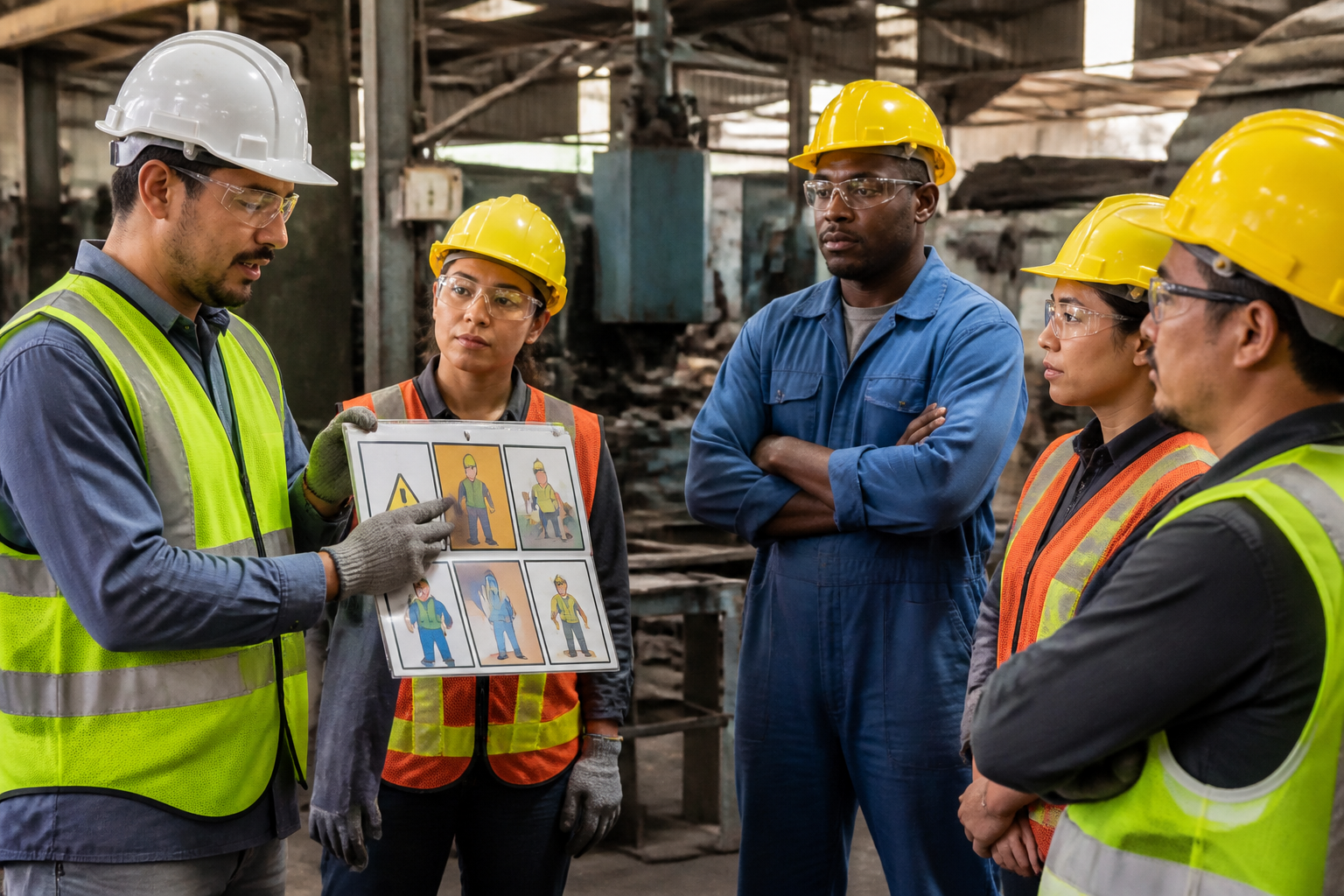
Verbal instructions alone rarely bridge significant language gaps. Incorporating physical actions into your bilingual toolbox talks ensures critical safety procedures cross language barriers.
Use "Do and Don't" Visual Cards
Replace text-heavy handouts with high-contrast photo guides. Show real photos of correct equipment setup alongside incorrect setups marked with a clear red X.
Demonstrate Equipment on the Spot
If the toolbox talk covers harness inspection, don't just talk about fraying straps. Hold up a worn harness, point directly to the damaged webbing, and physically demonstrate how to pull it out of service.
Standardize Universal Gestures
Establish site-wide hand signals for immediate safety actions, such as "stop work," "look up," or "wear eye protection." Reiterate these signals during every toolbox talk so workers associate spoken commands with physical cues.
Moving from Passive Listening to Active Verification
Asking "Does everyone understand?" or "Any questions?" usually results in nods, even when workers are confused. True comprehension requires active verification.
The "Show Me" Verification Method
Ask individual workers to physically demonstrate the safety procedure just discussed. If the talk covers lockout/tagout zero-energy verification, ask a worker to physically walk through the steps on an isolated breaker.
Rotating Crew Leads
Rotate who leads the practical demonstration portion of the talk. Having experienced Spanish-speaking workers lead the hands-on demonstration builds site leadership and reinforces peer-to-peer accountability.
Using structured bilingual toolbox talks combined with active verification eliminates guesswork on high-risk jobsites.
Essential Principles for Delivering Multilingual Safety Briefings
- Keep total talking time under 10 minutes to maintain high focus.
- Highlight 3 to 5 key safety vocabulary words in both English and Spanish on a portable whiteboard.
- Avoid complex idioms, industry jargon, or local slang that does not translate cleanly.
- Validate translations with native-speaking supervisors before the meeting to avoid confusing terminology.
- Record attendance and track comprehension using practical sign-off sheets that reflect demonstrated understanding.
Upskilling Supervisors for Seamless Safety Communication
Toolbox talks are only as effective as the leaders running them. When supervisors rely heavily on ad-hoc translation from frontline workers, it creates fatigue and dilutes authority. Training site supervisors to use key jobsite Spanish—and providing workplace ESOL for your frontline crew—transforms safety communication from a daily struggle into an operational strength.
Build a Safer Jobsite with Customized Language Training
Delivering clear bilingual toolbox talks is an essential step, but long-term safety requires systematic communication skills across your entire workforce. New Heights Languages delivers targeted workplace ESOL and supervisor Spanish courses designed specifically for manufacturing plants and construction sites.
Ready to eliminate language barriers on your floor or jobsite? [Book a free consultation](/contact) with our team to discuss customized language programs built around your operational schedules and safety standards.
<!-- featured image alt: A construction site supervisor conducting a bilingual toolbox talk with a mixed-language crew using visual safety cards. -->