How To Help Your Employees with Key Manufacturing Terminology
By New Heights Languages ·
As a language consultant, I always ask my students and their managers, "What are the 15-20 key terms that are most important to your company?" These should be words that are essential for safety, quality, and efficiency...

As a language consultant, I always ask my students and their managers, "What are the 15-20 key terms that are most important to your company?" These should be words that are essential for safety, quality, and efficiency and everyone needs to know ASAP- regardless of linguistic background. For employees who are beginner English learners—or supervisors communicating with non-English speakers—learning core manufacturing terminology is one of the fastest ways to reduce misunderstandings and build confidence. Focusing on the right words, and practicing them consistently, can make a noticeable difference in daily operations.
While I work on incorporating these words into stories in the classroom to emphasis listening and speaking, there are several things supervisors and other teammates can do on the floor to help reinforce what their teammates are learning in class.
Essential Manufacturing Terms for Beginners
When training ESL learners or bilingual teams, start with high-frequency, job-critical vocabulary. Some key categories include:
- Safety terms: stop, danger, emergency, wear (PPE), gloves, helmet, glasses
- Tools and equipment: machine, press, forklift, conveyor, button, lever
- Actions and processes: start, stop, load, unload, check, fix, clean
- Quality and production: good, bad, defect, measure, count, finished
- Time and sequence: now, before, after, first, last, shift, break
These words appear repeatedly during a shift and give learners immediate, usable language they can apply right away.
Tips for Practicing Terminology in the Workplace
- Label the environment
Use labels or signage on machines, tools, and workstations. Seeing the word while performing the task reinforces memory and builds confidence without slowing production.
- Model and repeat
Supervisors should consistently use the same words for the same tasks. Repetition helps learners connect language to action and reduces confusion caused by switching terms.
- Use short practice moments
Practice doesn’t have to be formal, but is a great way to reinforce what we do in class at New Heights English. Asking a quick question during a shift—“Is this good or bad?” or “What do we do first?”—creates real-world learning opportunities.
- Pair language with visuals and gestures
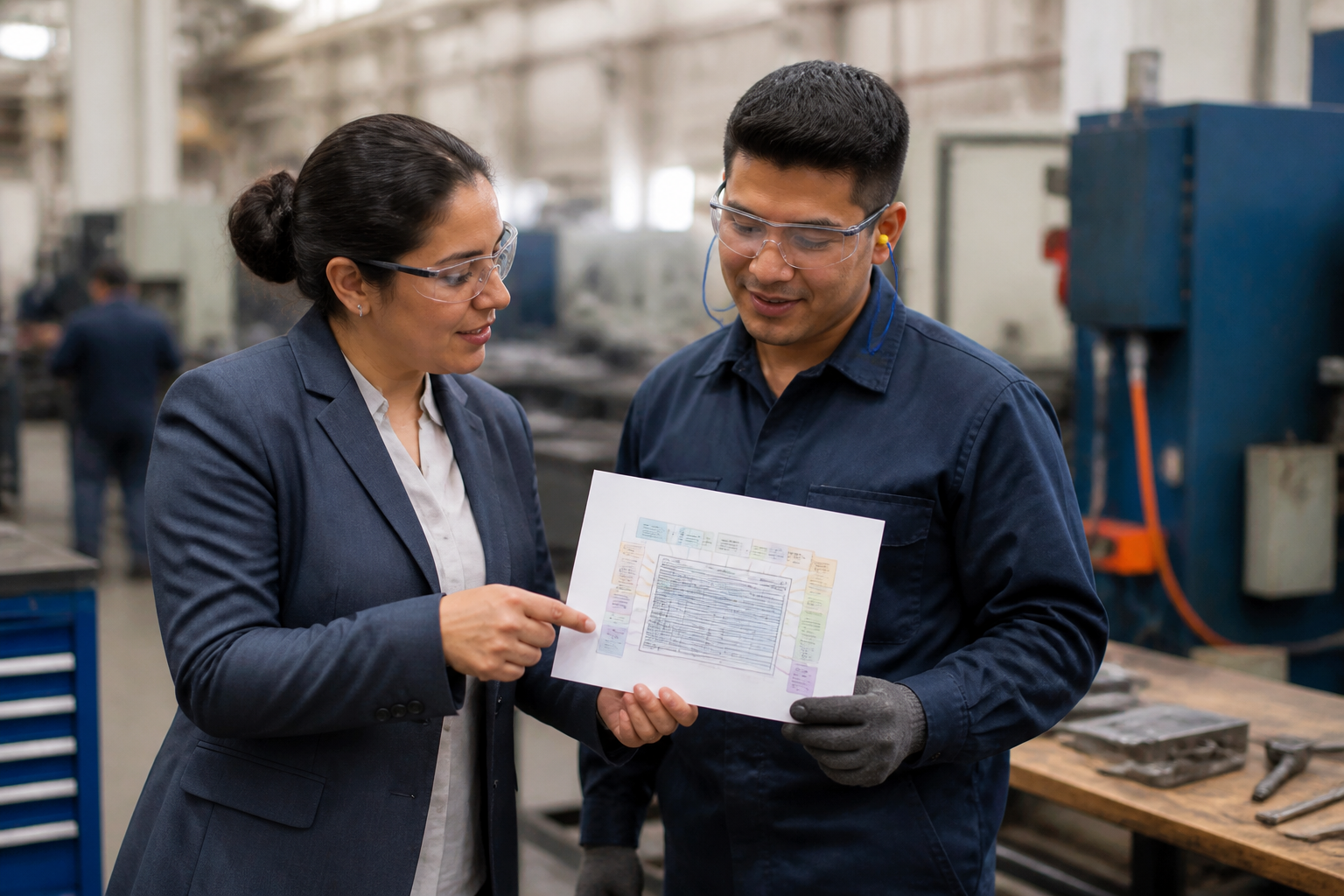
Pointing, demonstrating, and using photos or diagrams strengthens understanding, especially for beginners who may struggle with pronunciation or listening comprehension.
- Encourage safe correction
Create a culture where it’s okay to ask questions and make mistakes. Gentle correction helps employees improve without fear or embarrassment.
At New Heights English, we help manufacturing teams build practical language skills that improve safety, productivity, and morale. Our ESL and Spanish classes are tailored to real workplace terminology—not textbook language that never gets used on the floor.
We also offer a free 90-minute beginner class in either ESL or Spanish, which can be booked directly on our website. To learn more or get started, contact us at info@NewHeightsEnglish.com. Investing in workplace language training is an investment in clearer communication and a stronger, safer team.