Industrial Laundry Chemical Safety ESL Guide
By New Heights Languages ·
Protect wash floor technicians from severe chemical burns and toxic gas hazards with practical language training for commercial laundry operations.
Commercial laundry facilities process thousands of pounds of textiles daily, relying on heavy-duty chemical formulations to achieve sanitization, stain removal, and fabric conditioning. Wash floor technicians handle concentrated alkalis, chlorine bleaches, organic acids, and hydrogen peroxide. When workers have limited English proficiency (LEP), standard English safety manuals fall short. Addressing industrial laundry chemical safety ESL communication gaps is essential to prevent catastrophic chemical burns, toxic gas releases, and costly OSHA citations.
Industrial laundries run high-volume washer-extractors and continuous batch tunnel washers. The chemicals feeding these systems operate under high pressure and intense concentrations. This guide provides plant managers, safety directors, and HR leaders with practical tactics to bridge language barriers on the wash floor.
The High-Stakes Chemical Hazards of the Wash Floor
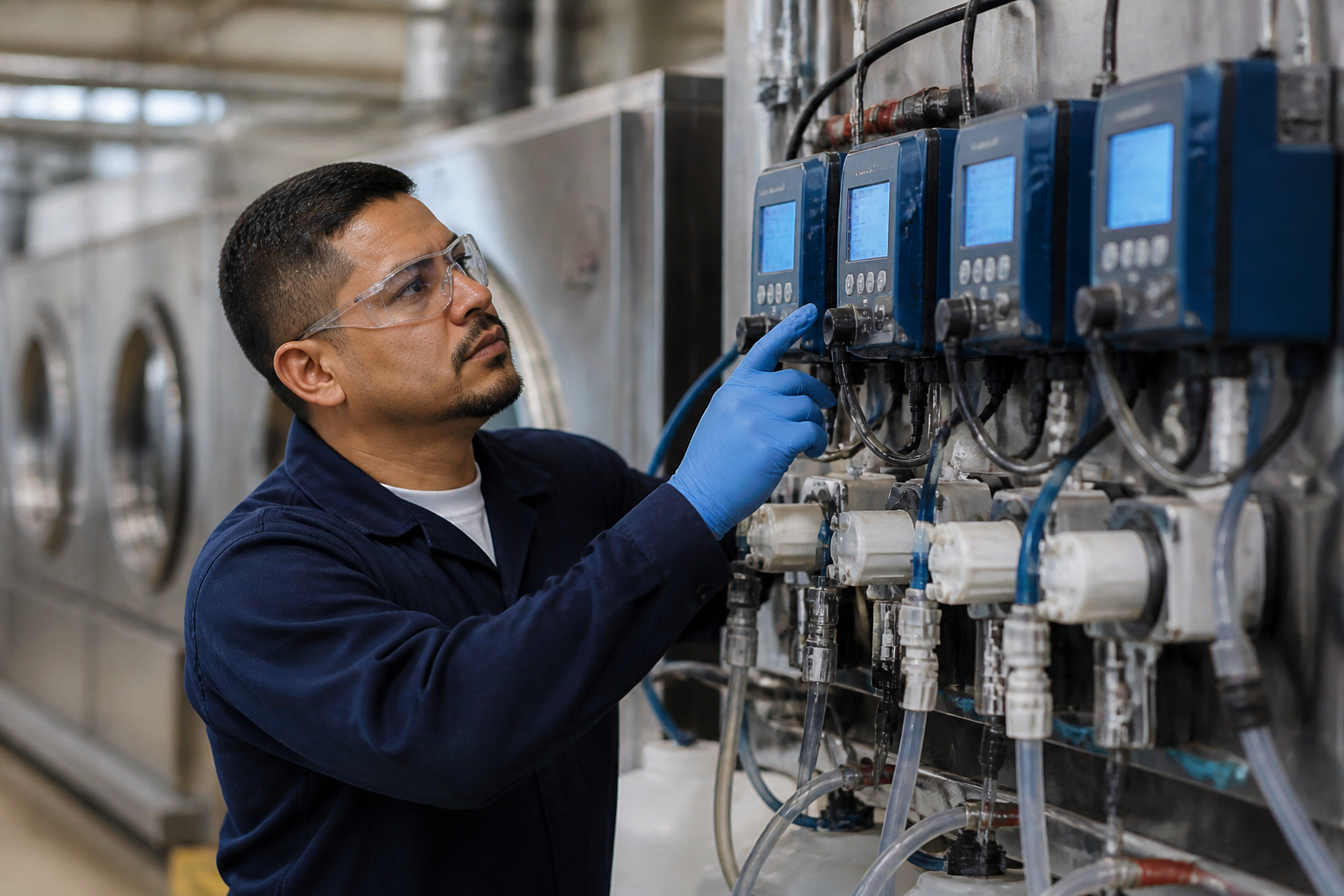
Unlike household laundering, commercial wash floors utilize raw chemical concentrates delivered via automated peristaltic pump manifolds or direct drum dispensing. Understanding the specific hazards workers face daily highlights why clear, non-ambiguous communication is critical.
Caustic Alkalis and Chemical Burns
Sodium hydroxide and potassium hydroxide are foundational to heavy-duty wash formulas. They break down organic soils and greases at high pH levels (often above 12). Contact with concentrated alkali liquid causes rapid tissue destruction without immediate pain, leading to deep, severe chemical burns before a worker realizes the skin has been exposed.
Incompatible Chemical Reactions
The most severe acute risk on a wash floor occurs when incompatible chemicals mix. Combining sodium hypochlorite (chlorine bleach) with acidic laundry sours (such as fluorosilicic or phosphoric acid) instantly releases lethal chlorine gas. If a technician misreads drum labels during a pump line changeover or chemical swap, the resulting vapor cloud can trigger an immediate facility evacuation.
Titration and Manual Chemical Handling
Even with automated injection systems, wash floor technicians perform manual titrations, test bath pH, swap chemical drums, and prime chemical lines. Opening sample valves or changing intake tubes exposes technicians to chemical splashes and pressurized spray.
Overcoming Language Barriers in GHS Compliance
Globally Harmonized System (GHS) pictograms provide basic hazard warnings, but pictograms alone cannot convey facility-specific handling procedures. Improving industrial laundry chemical safety for ESL workers requires moving beyond passive signage to active, operational comprehension.
Translating and Visualizing Secondary Container Labels
While original chemical drums ship with manufacturer GHS labels, secondary containers—such as titration sample bottles, floor buckets, and portable spray bottles—are frequently mislabeled or left blank.
Ensure secondary container labels feature:
- Dual-language chemical names (e.g., English and Spanish or Vietnamese).
- Color-coded system identifiers matching the pump line manifolds.
- Clear hazard icons for corrosive, toxic, or oxidizer risks.
- Maximum bath concentrate dilution ratios.
Navigating Safety Data Sheets (SDS) Beyond English
OSHA requires accessible Safety Data Sheets for every chemical on site. However, an English SDS binder in a breakroom provides zero protection for a non-native English speaking wash floor technician during a chemical spill.
Maintain digital or printed SDS summaries in the primary language of your workforce. Focus these localized sheets on Section 4 (First-Aid Measures), Section 8 (Exposure Controls/Personal Protection), and Section 10 (Stability and Reactivity).
Practical Floor Protocols for Multilingual Laundry Teams
Establishing operational controls reduces reliance on written text alone. Build a visual, structured system that reinforces safe handling habits directly on the wash floor.
Color-Coded Chemical Line Mapping
Never rely on chemical product names alone when training workers to trace supply lines. Implement a standardized color-coding system across the entire wash aisle:
- Blue: Built Detergent / Alkali
- Yellow: Chlorine Bleach / Sanitizer
- Red: Acidic Sour / Neutralizer
- Green: Softener / Antistat
- Clear/White: Hydrogen Peroxide / Oxygen Bleach
Paint or pipe-wrap the intake lines, peristaltic pump heads, and injection points to match these colors. When instructing technicians to change out supply containers, reference both the English chemical term and the system color.
Verification Protocols for Chemical Drum Changeovers
Changing out empty 55-gallon drums or 300-gallon totes carries significant exposure risk. Implement a physical two-person verification protocol using a simple English verbal confirmation checklist:
1. Read the Name: Worker A reads the replacement drum label out loud in English.
2. Verify the Color: Worker B confirms the intake tube color tag matches the drum label tag.
3. Check the PPE: Both workers inspect each other's Personal Protective Equipment before opening the chemical bung.
4. Confirm Connection: Worker A verifies the pump line is secure before opening the drum vent valve.
Targeted Language Training for Wash Floor Technicians
Generic workplace English courses do not cover terms like titration, peristaltic pump, caustic, or eyewash station. Commercial laundries need focused language training tailored to daily machinery and chemical workflows.
Essential Workplace Vocabulary for Wash Floor Safety
Ensure all wash floor employees master core safety commands and industry vocabulary, including:
- Hazard Terms: Acid, Alkali, Bleach, Oxidizer, Corrosive, Toxic Gas, Pressure Line.
- PPE Items: Face Shield, Nitrile Gloves, Chemical Apron, Rubber Boots, Eyewash.
- Action Words: Flush, Prime, Lockout, Vent, Neutralize, Evacuate, Spill.
- Status Terms: Leaking, Empty, Over-pressurized, Incompatible, Clamped.
Emergency Response Drills and Verbal Commands
When a chemical hose ruptures or a splash occurs, immediate action is required. Workers cannot afford to hesitate while translating instructions in their heads. Practice physical drills focused on clear, high-priority spoken phrases:
- "Flush eyes now!"
- "Stop the chemical pump!"
- "Chemical leak on Line 3!"
- "Get the face shield!"
Integrate physical demonstrations with spoken English response drills. Have technicians walk to the nearest eyewash station, demonstrate pull-handle activation, and articulate the immediate steps for skin exposure.
Build a Safer, Compliant Wash Floor Operation
Investing in industrial laundry chemical safety ESL programs protects your workforce, reduces chemical waste, and prevents costly operational downtime caused by hazardous spills or chemical cross-contamination.
At New Heights Languages, we specialize in customized workplace English and Spanish training for industrial laundry, manufacturing, and construction employers. We bring practical, job-specific language training directly to your plant floor—helping your wash floor technicians communicate safely and confidently under pressure.
Ready to eliminate language barriers on your wash floor? [Book a free consultation with our language training experts today](/contact).
<!-- featured image alt: A commercial laundry wash floor technician in protective eyewear inspecting automated chemical injection pumps. -->