Introducing Plant Automation for Limited English Workers
By New Heights Languages ·
Successfully roll out industrial automation with limited English workers. Learn strategies for HMI training, safety, and bilingual shop floor leads.
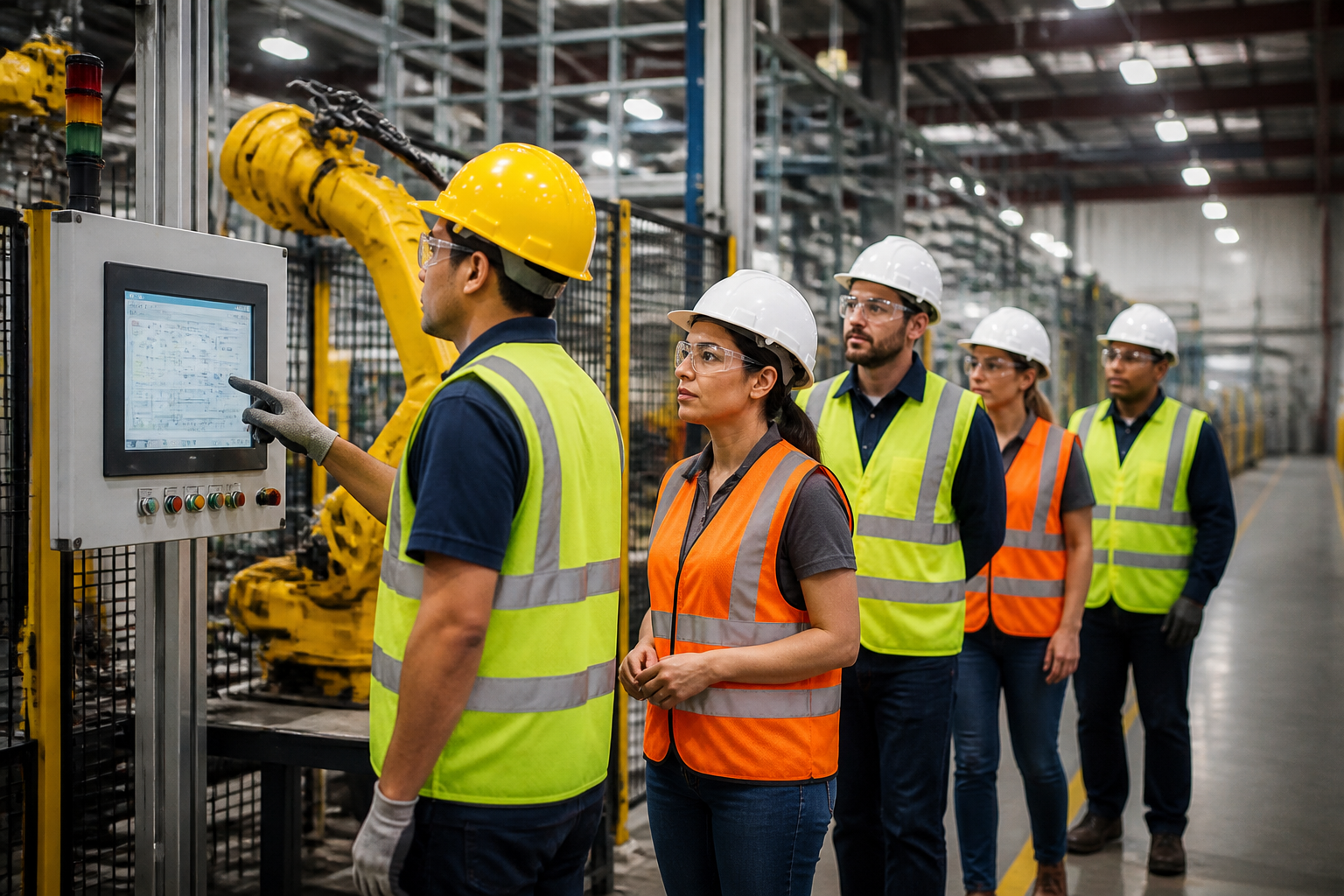
When manufacturing facilities upgrade line technology, long-term success depends entirely on the operators running the floor. Successfully introducing plant automation to limited English workers requires more than installing cobots, automated guided vehicles (AGVs), or human-machine interfaces (HMIs) and handing out an English user manual. Without a dedicated workforce communication strategy, technology rollouts trigger unnecessary anxiety, slow production throughput, and lead to costly operator errors.
When plant leadership treats automation training as a language-inclusive initiative, equipment adoption rates surge and unplanned downtime drops. Here is how plant managers, continuous improvement leaders, and HR directors can bridge the communication gap during complex automation rollouts.
The Friction Point: Tech Anxiety vs. Language Barriers
When operators with limited English proficiency (LEP) see new automated machinery arrive, their immediate reaction is often fear of job displacement or fear of breaking expensive equipment. When training materials and interface screens are exclusively in complex technical English, that anxiety doubles.
Workers may hesitate to touch control panels, misinterpret fault codes, or revert to manual workarounds that bypass automated safety interlocks. The goal of floor-level training is not to turn every operator into a systems engineer. The goal is to build operational confidence by matching new machine vocabulary directly with practical, physical tasks on the line.
Map HMI Terminology to Operational Floor Vocabulary
Human-Machine Interfaces (HMIs) are the primary touchpoint for machine operators. If an HMI displays technical alerts like "Axis 3 Overtravel" or "Feed Hopper Photocell Blocked," limited-English employees might struggle to take immediate corrective action.
Plant leaders must standardize technical terminology across the facility long before the equipment goes live.
Build Visual Keypads and Dual-Language Callouts
Create physical reference cards mounted directly adjacent to HMI screens. Use high-contrast diagrams mapping exact screen buttons to their real-world functions in both English and the primary native languages spoken on your shop floor.
Standardize Universal Alarm Vernacular
Group common automation alerts into simplified, high-priority English action words:
- Fault / Clear: Teach operators to recognize the exact alert phrase on screen, verify the physical jam point, and execute the clearance routine.
- Reset / Cycle Start: Pair the digital touch-screen prompt with the physical action required to re-engage the automated cell.
- E-Stop / Reset Required: Standardize the exact sequence for pulling the physical emergency stop button versus clearing the software latch on screen.
Train Lead Operators as Bilingual Automation Champions
Vendor-led training sessions rarely translate well for LEP employees. Original Equipment Manufacturer (OEM) technicians usually deliver dense, fast-paced technical lectures in English, assuming high familiarity with industry jargon.
To bridge this gap, select key bilingual lead operators to attend the OEM training first. Partner these leads with targeted language instruction so they can translate technical automation concepts into clear, everyday work instructions for their peers.
When introducing plant automation, limited English workers learn faster from peer leaders who understand both the new equipment mechanics and the cultural nuances of the shift crew. These champions provide real-time coaching on the floor during normal production runs.
Conduct Micro-Step Hands-On Demos
Classroom presentations rarely build machine operating skills for non-native English speakers. Shift your automation training strategy to practical, micro-step walkthroughs directly at the work cell.
Break automated machine operation down into discrete, repeatable modules:
- Pre-start inspection and power-up sequences
- Selecting part recipes on the touchscreen
- Clearing minor sensor jams without triggering light curtain faults
- Logging scrap material or vision system rejects correctly
- End-of-shift lock-out and sanitation prep
During these walkthroughs, require operators to demonstrate physical execution while stating key English terms (e.g., "Clear jam," "Reset light curtain," "Recipe select"). This reinforces technical vocabulary through physical muscle memory.
Align Automation Safety Protocols with Language Training
Automated lines introduce distinct safety risks, including sudden machine movements, robot work cells, and automated conveyances. Standard safety briefings in English are insufficient for complex automated environments.
When introducing plant automation to limited English workers, ensure safety compliance by addressing high-risk points directly:
- Perimeter hazard labeling: Use clear visual safety symbols combined with target vocabulary (e.g., "Keep Out / Automated Start").
- Light curtain recovery: Walk employees through what happens when a light curtain barrier is broken, teaching the exact English prompts displayed when resetting the perimeter safely.
- Lockout/Tagout (LOTO) verification: Ensure zero-energy verification protocols use clear language commands during maintenance and changeovers.
Measure Automation Adoption Across Language Lines
Track operational metrics before and after implementing language-aligned automation training. Compare overall equipment effectiveness (OEE), scrap rates, and fault resolution time between shifts.
If Shift 1 (primarily native English speakers) clears robot cell faults in 3 minutes while Shift 2 (primarily LEP workers) takes 14 minutes, the issue is rarely operator capability—it is a training and communication bottleneck. Identifying these operational gaps allows HR and plant management to target language training precisely where downtime is occurring.
Addressing the challenges of introducing plant automation among limited English workers protects capital investment and ensures equipment reaches design speed faster.
Build a Language-Ready Workforce for Your Next Line Upgrade
Capital investments in industrial automation only pay off when frontline operators know how to run, troubleshoot, and maintain the equipment safely. By aligning targeted language training with your plant’s technology roadmap, you protect your machinery investment and build a resilient workforce.
New Heights Languages delivers customized workplace English and Spanish training programs designed specifically for manufacturing and industrial environments. We help your employees master the practical language needed to run automated equipment, follow SOPs, and maintain high throughput.
Contact us today to [book a free consultation](/contact) and discover how tailored language training can accelerate your next plant automation rollout.
<!-- featured image alt: A manufacturing operator interacting with a digital touch screen panel next to automated robotic machinery on a factory floor. -->