Meeting OSHA Language Requirements on the Floor
By New Heights Languages ·
Understand OSHA language requirements for safety training. Learn how manufacturers and builders ensure non-English fluent workers understand hazards.

When managing a plant or job site with limited English proficient (LEP) employees, meeting osha language requirements is not just a best practice—it is a mandatory legal obligation. OSHA regulations mandate that safety training must be delivered in a manner that workers can actually comprehend. If an employee cannot understand safety protocols, chemical hazard warnings, or machinery operating procedures presented to them, the training is legally considered incomplete.
The "Understandable Manner" Standard
OSHA's official policy guidelines under the General Duty Clause (Section 5(a)(1)) and specific training standards establish clear expectations regarding language access. OSHA issued an explicit policy memo stating that training standards require employers to present safety information in a language and vocabulary that their employees understand.
Beyond Word-for-Word Translation
An employer cannot fulfill this obligation simply by handing a non-English-speaking worker an English safety manual, having them sign an attendance roster, or running English text through basic automated translation software.
OSHA expects that if a worker's primary language is Spanish, Vietnamese, or another language, and their English proficiency is limited, training must be conducted in their primary language or supported by qualified bilingual instruction. Furthermore, vocabulary level matters just as much as language choice. Using complex medical or legal jargon in any language fails the compliance test if frontline workers cannot digest the material.
Key OSHA Standards Impacting Multilingual Crews
While the general rule applies across all operations, several specific standards trigger intense scrutiny regarding osha language requirements:
Hazard Communication Standard (29 CFR 1910.1200 / 1926.59)
The Hazard Communication Standard (HazCom) relies heavily on worker comprehension. Employees must understand chemical labels, Safety Data Sheets (SDS), visual GHS pictograms, and signal words ("Danger" vs. "Warning"). If workers interact with hazardous chemicals, employers must ensure they understand the exact hazards and emergency response steps, regardless of native language.
Control of Hazardous Energy / Lockout-Tagout (29 CFR 1910.147)
Lockout/Tagout (LOTO) procedures carry severe risks if misunderstood. Authorized employees who execute lockout procedures and affected employees who work around locked-out equipment must understand energy isolation steps. OSHA inspectors regularly check whether non-English speaking operators clearly understand tagout warnings and lockout sequence details.
Personal Protective Equipment (29 CFR 1910.132 / 1926.95)
Employers must train employees on when PPE is necessary, what PPE is required, how to properly don, doff, adjust, and wear PPE, and its limitations. Explaining proper respirator fit or hearing protection noise reduction ratings requires clear, unambiguous communication.
Emergency Action Plans (29 CFR 1910.38 / 1926.35)
During an emergency evacuation, chemical spill, or severe weather event, frontline workers must know immediately where to go and what to do. Emergency alarm signals and evacuation routes must be clearly explained in languages understood by the entire workforce.
How OSHA Audits Safety Training Comprehension
During a workplace inspection, an OSHA compliance officer will not rely solely on written records or signed sign-in sheets. Signed attendance records prove presence, not understanding.
Inspectors frequently conduct private, one-on-one interviews with frontline employees. If an inspector identifies limited English proficient workers, they will utilize a qualified interpreter to interview those workers directly on the production floor or job site.
An inspector might ask employees questions such as:
- "Can you show me where the Safety Data Sheet for this cleaning solvent is located?"
- "What does this yellow tag on the machine mean?"
- "What steps do you take before clearing a jam on this conveyor?"
- "What does your supervisor tell you to do if you hear the emergency alarm?"
If the worker cannot answer these questions accurately because they never understood the initial training, OSHA can cite the employer for failure to train under the relevant standard—regardless of whether the employer has a signed training sheet on file.
4 Common Language Compliance Pitfalls
Many well-intentioned manufacturers and construction contractors fall into predictable traps when trying to satisfy osha language requirements.
- Relying on ad-hoc translation by bilingual operators: Asking a bilingual machine operator to translate complex machinery safety rules on the spot often leads to missing technical details, incorrect terms, and unreliable instruction.
- Translating documents without addressing literacy: Written translations fail if employees have low native-language literacy skills. Visual aids, practical demonstrations, and spoken instruction are vital.
- Ignoring dialect and regional technical terms: Translating safety terminology into formal textbook Spanish when your crew uses regional industrial slang can lead to confusion during high-risk operations.
- Treating language access as a one-time onboarding event: Language access and safety reinforcement must be continuous. Annual refresher training must meet the same language clarity standards as initial orientation.
Building a Defensible Language-Accessible Safety Plan
To meet osha language requirements and effectively protect your workforce, employers should adopt a structured approach to floor communication.
Combine Targeted ESOL with Safety Training
Instead of relying permanently on full translation or interpreters, progressive manufacturers invest in targeted workplace ESOL training. By teaching frontline workers job-specific English terms—such as safety warnings, machine parts, and hazard vocabulary—you build long-term English capability while satisfying regulatory obligations.
Implement the "Teach-Back" Verification Method
Never ask a worker, "Do you understand?" Most workers will nod out of courtesy or fear of looking incompetent. Instead, use the teach-back method: ask the worker to explain the safety step back to you in their own words or physically demonstrate the safe procedure.
Audit Your Bilingual Safety Assets Regularly
Audit your floor signage, SDS binders, equipment operating procedures, and emergency routes annually. Ensure all translations are accurate, culturally clear, and matched to the specific dialect and literacy levels of your frontline workforce.
Bridge the Gap on Your Plant Floor
Complying with OSHA language standards isn't just about avoiding costly citations—it's about ensuring every operator on your floor returns home safely at the end of every shift. Equipping your supervisors and frontline employees with clear, practical workplace language skills closes the gap between written policy and daily practice.
Want to evaluate your facility's language safety compliance and build a custom workplace English or Spanish program for your team? Book a free consultation at /contact with New Heights Languages today.
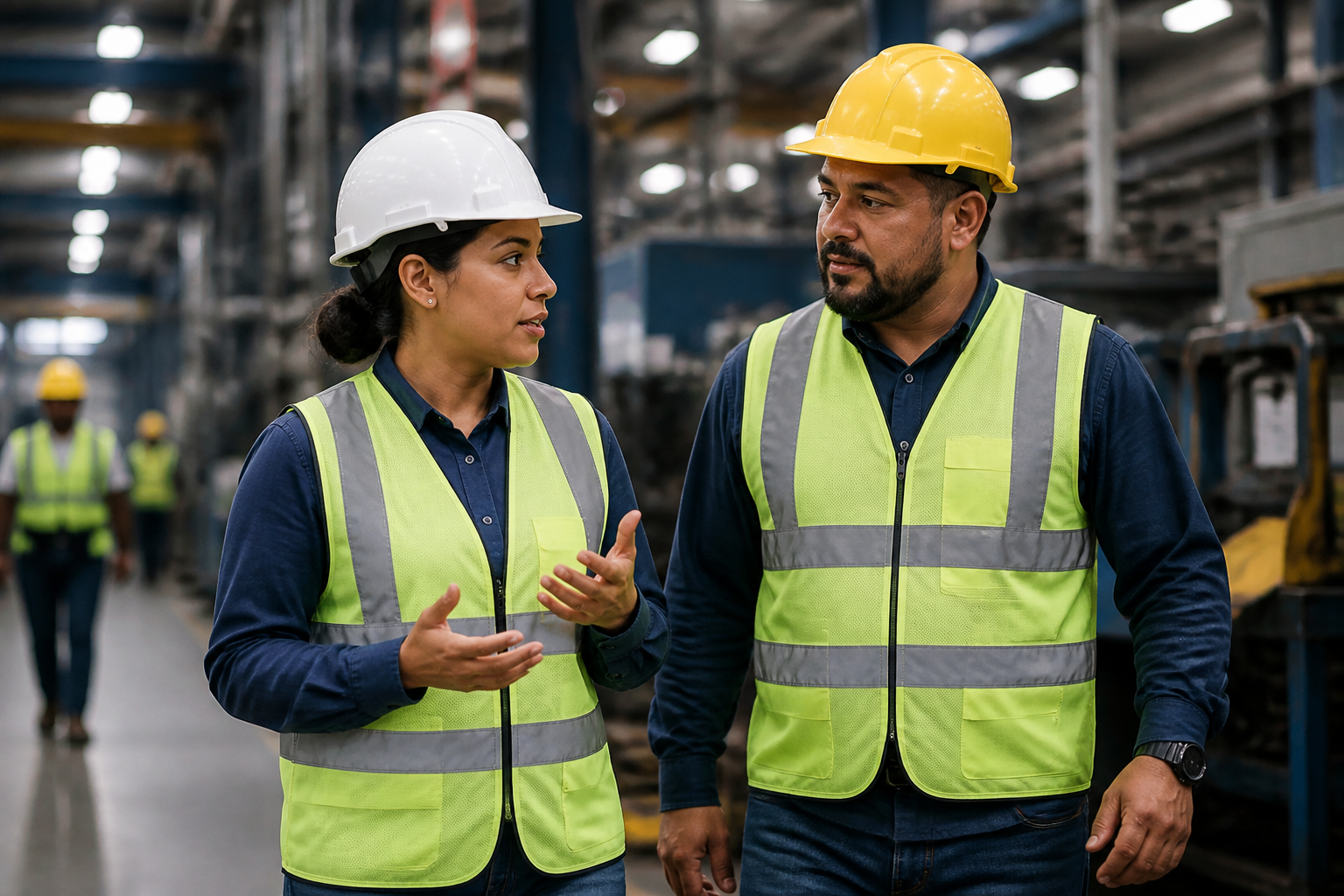
<!-- featured image alt: A safety manager in a high-visibility vest reviewing a multilingual safety checklist with a manufacturing plant worker. -->