Warehouse Pedestrian Safety: Multilingual Crew Guide
By New Heights Languages ·
Prevent warehouse struck-by accidents with targeted pedestrian safety protocols, visual cues, and site-specific vocabulary for multilingual logistics crews.
High-velocity logistics hubs rely on constant motion. Forklifts, reach trucks, and electric pallet jacks share narrow aisles with order pickers, pack stations, and maintenance technicians. When equipment traffic and foot traffic mix under tight fulfillment deadlines, struck-by hazards skyrocket. Building an effective system for warehouse pedestrian safety with a multilingual crew requires moving beyond passive translated signs. Operations managers and safety directors must embed active, repeatable communication habits into every shift.
Struck-by incidents remain one of the leading causes of severe injuries in material handling. In facilities with diverse workforces, safety breakdowns rarely happen because workers ignore rules intentionally. Instead, near-misses occur when verbal warnings are misunderstood, visual cues are ignored during rush periods, or floor-level safety expectations are lost across language barriers.
Mapping High-Risk Intersections and Visual Right-of-Way
Physical controls provide the first line of defense, but their success depends on whether workers fully grasp how to interact with them on a fast-moving floor.
Standardizing Blue Spotlights and Visual Distances
Pedestrian spotlight systems (such as forward and rear blue LEDs mounted on forklifts) provide early visual warnings around rack corners. However, new employees often do not realize the distance rules tied to these lights.
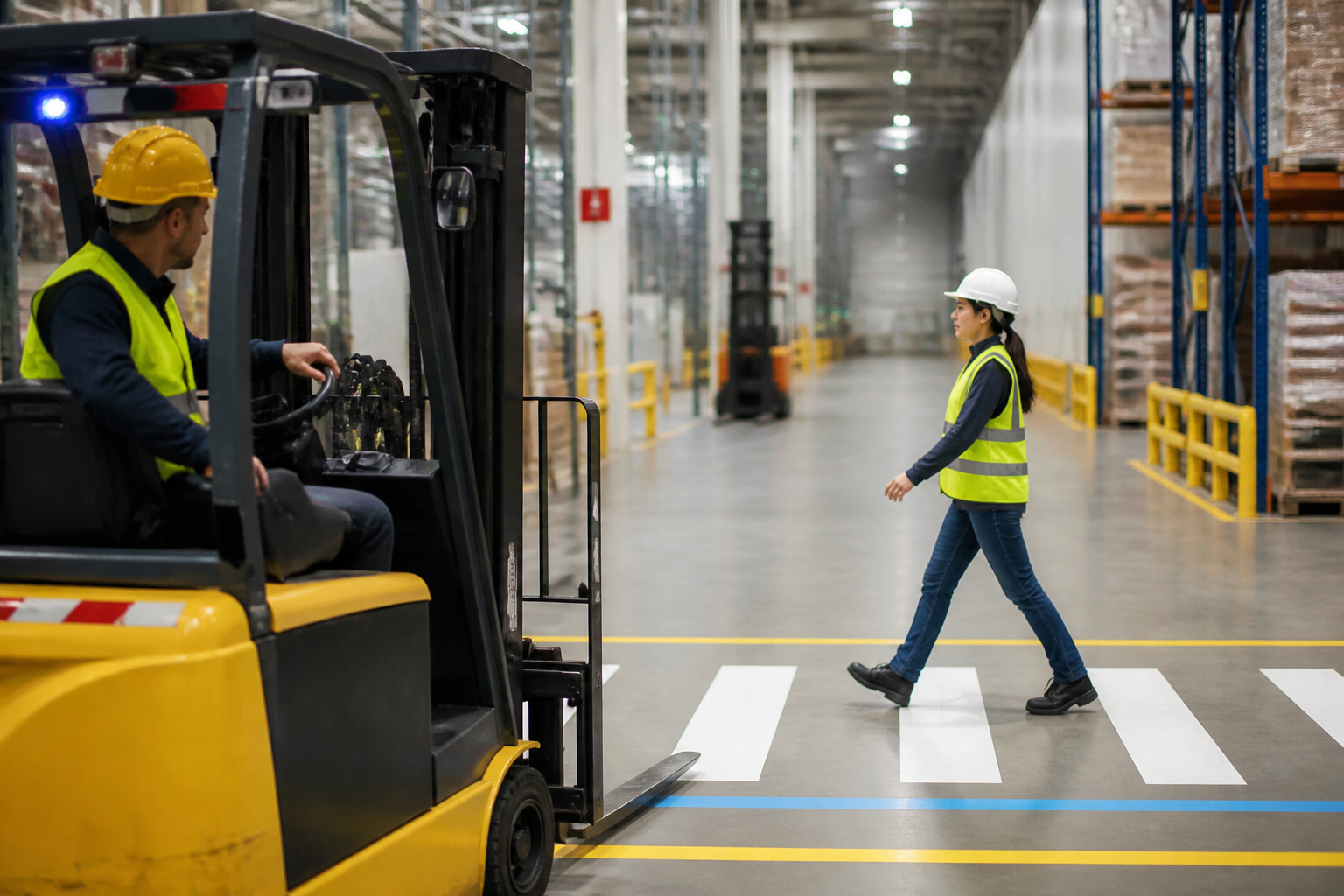
Train equipment operators and pedestrians on a strict baseline rule: if a pedestrian sees a blue light projecting on the floor, they must freeze and make eye contact with the driver before moving. Do not rely on workers to read lengthy English safety manuals regarding spotlight distances. Practice this visual rule physically on the warehouse floor during onboarding.
Standardizing Floor Markings and Physical Barriers
Physical guardrails and painted walkways keep foot traffic separate from heavy machinery. However, fulfillment pressures often lead workers to take shortcuts across painted staging areas.
Ensure that pedestrian gates, crosswalk lines, and designated staging zones are clear and enforced without exception. Use consistent colors across all warehouse zones:
- Yellow Lines: Equipment-only travel lanes and active staging zones.
- Green Lines: Designated pedestrian walkways and emergency escape routes.
- Red Stenciled Boxes: Keep-clear zones around electrical panels, eye-wash stations, and fire extinguishers.
Developing Universal Auditory and Hand Signal Protocols
Engine noise, shrink-wrap machines, and automated conveyors create high decibel levels in logistics centers. When noise is paired with limited English proficiency, traditional verbal shouts like "Heads up!" or "Watch out!" fail to convey critical directional warnings.
Three-Second Horn and Eye Contact Rules
Establish a standardized horn protocol for all powered industrial truck (PIT) operators. Equipment operators must sound a three-second horn tap before:
1. Entering any main aisle intersection.
2. Backing out of a storage rack bay.
3. Passing through plastic strip curtains or rollup doors.
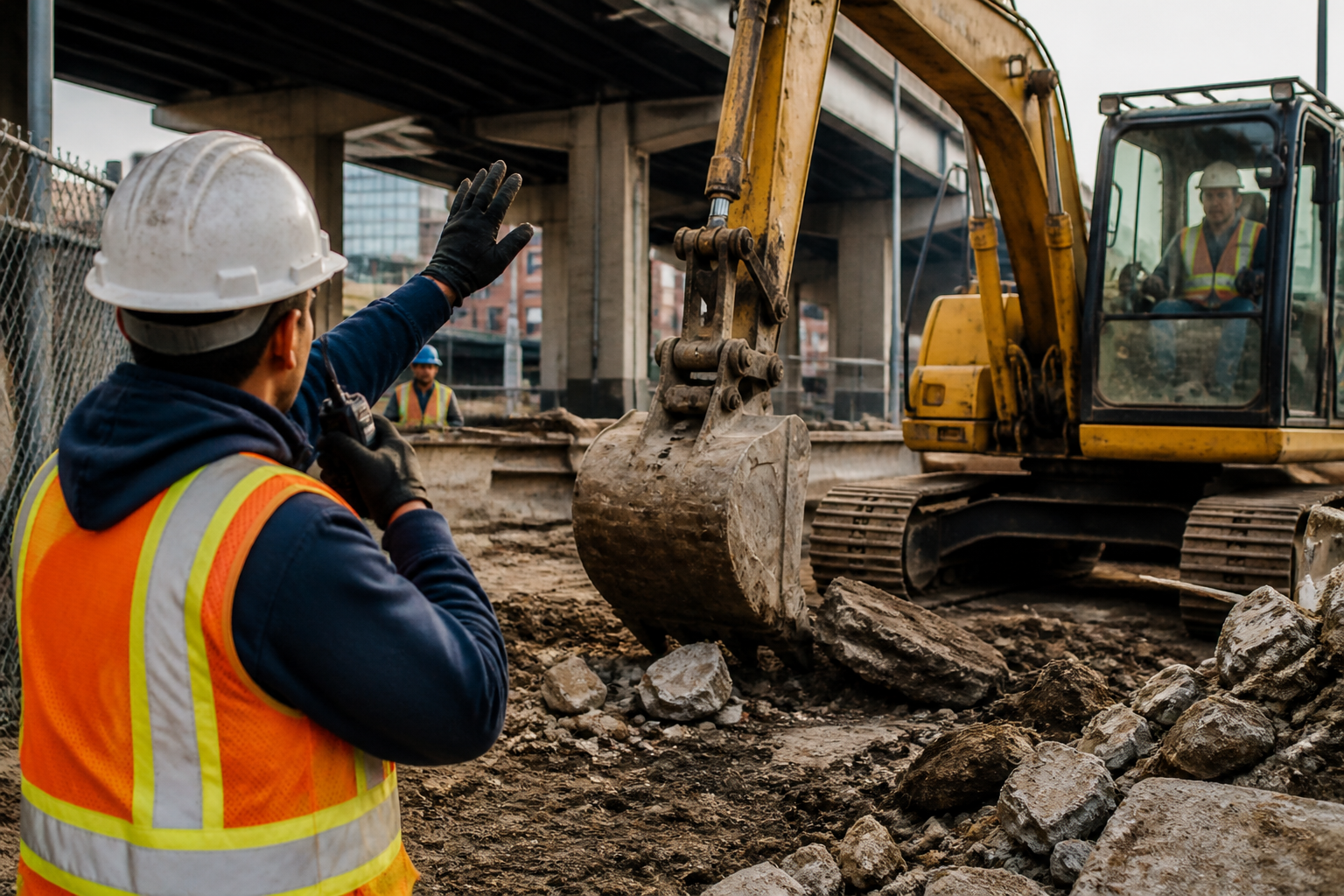
Pedestrians must respond with a uniform hand signal—a clear open-palm "stop" sign raised at shoulder height—confirming they acknowledge the truck's movement. Establishing explicit hand signals removes the ambiguity of quick verbal exchanges across different native languages.
Mandatory Directional Callouts on the Rack Aisle
While hand signals work within line of sight, workers hidden in rack aisles need predictable verbal callouts. Teach short, high-impact English phrases that every shift member uses identically:
- "Rack aisle [Number] active!" when entering a tunnel with an order picker.
- "Behind you!" when walking past a stationary worker at a pick location.
- "Clear to back!" when spotting an operator maneuvering in tight quarters.
Repeated drill practice ensures these critical safety terms become automatic reflexes for native and non-native English speakers alike. Strengthening warehouse pedestrian safety for a multilingual crew depends heavily on this consistent verbal standard.
Practical Floor-Level Safety Drills for Forklift and Foot Traffic
Classroom presentations and slideshows do not change habits on the warehouse floor. Safety protocols must be practiced in the actual physical environment where equipment operates.
High-Visibility Vest and Personal Protective Equipment Protocols
Every individual walking into an active logistics zone—including temporary labor, supervisors, and administrative staff—must wear high-visibility vests. Implement color-coded vest systems to instantly identify roles:
- High-Vis Yellow: Certified PIT operators.
- High-Vis Orange: Pedestrian order pickers and floor staff.
- High-Vis Green with Text: Safety leads and shift supervisors.
This visual hierarchy allows equipment operators to instantly gauge the movement patterns and experience levels of nearby workers.
Micro-Drills for Blind-Corner Approaching
Conduct 5-minute micro-drills at problem intersections during shift huddles. Have a supervisor walk a small group to a high-traffic intersection and simulate blind-corner scenarios:
- Have an operator drive toward the intersection while sounding the horn.
- Practice pedestrian stopping points behind protective bollards.
- Practice the operator's stopping sequence when a pedestrian steps onto the walkway unexpectedly.
These brief, frequent physical demonstrations reinforce safety habits far more effectively than reading written policies.
Incident Reporting and Near-Miss Tracking for Multilingual Logistics Teams
Near-misses are early warnings of future collisions. If workers feel unable to explain a near-miss due to language barriers, critical safety data is lost until a serious accident occurs.
Removing Language Barriers from Near-Miss Logs
Simplify near-miss reporting processes. Replace text-heavy accident forms with visual report cards or digital kiosk inputs featuring facility maps and simple icon selections:
- Equipment type involved (forklift, reach truck, walkie-stacker).
- Incident location (aisle number, dock door, packing area).
- Hazard type (pedestrian cut off, failed horn warning, blocked crosswalk).
Allow workers to submit voice notes or native-language descriptions. Dedicated bilingual team leads or translation tools can translate the reports for root-cause analysis.
Daily Huddle Spot-Checks
During daily pre-shift meetings, review near-miss trends from the previous day. Use visual aids or physical demonstrations to highlight what happened and how the team can prevent a recurrence. When workers see that near-miss reports directly lead to safer floor conditions, participation increases across every shift.
Optimizing warehouse pedestrian safety across a multilingual crew requires a blend of clear floor architecture, standardized auditory callouts, and continuous practical training.
Elevate Safety Performance in Your Logistics Operation
Is your facility looking to reduce struck-by risks, improve forklift-pedestrian communication, and align your shift teams around standardized safety protocols? New Heights Languages designs customized workplace English and Spanish training programs tailored directly to logistics, distribution, and manufacturing operations.
[Book a free consultation today](/contact) to learn how we can help you build a safer, more productive workforce.
<!-- featured image alt: A forklift operator stops at a warehouse intersection while a pedestrian worker wearing a high-visibility vest crosses safely. -->