Crane Rigging Communication Language Barrier Construction
By New Heights Languages ·
Standardize crane hand signals and radio protocols across mixed English and Spanish construction crews to prevent jobsite accidents and downtime.
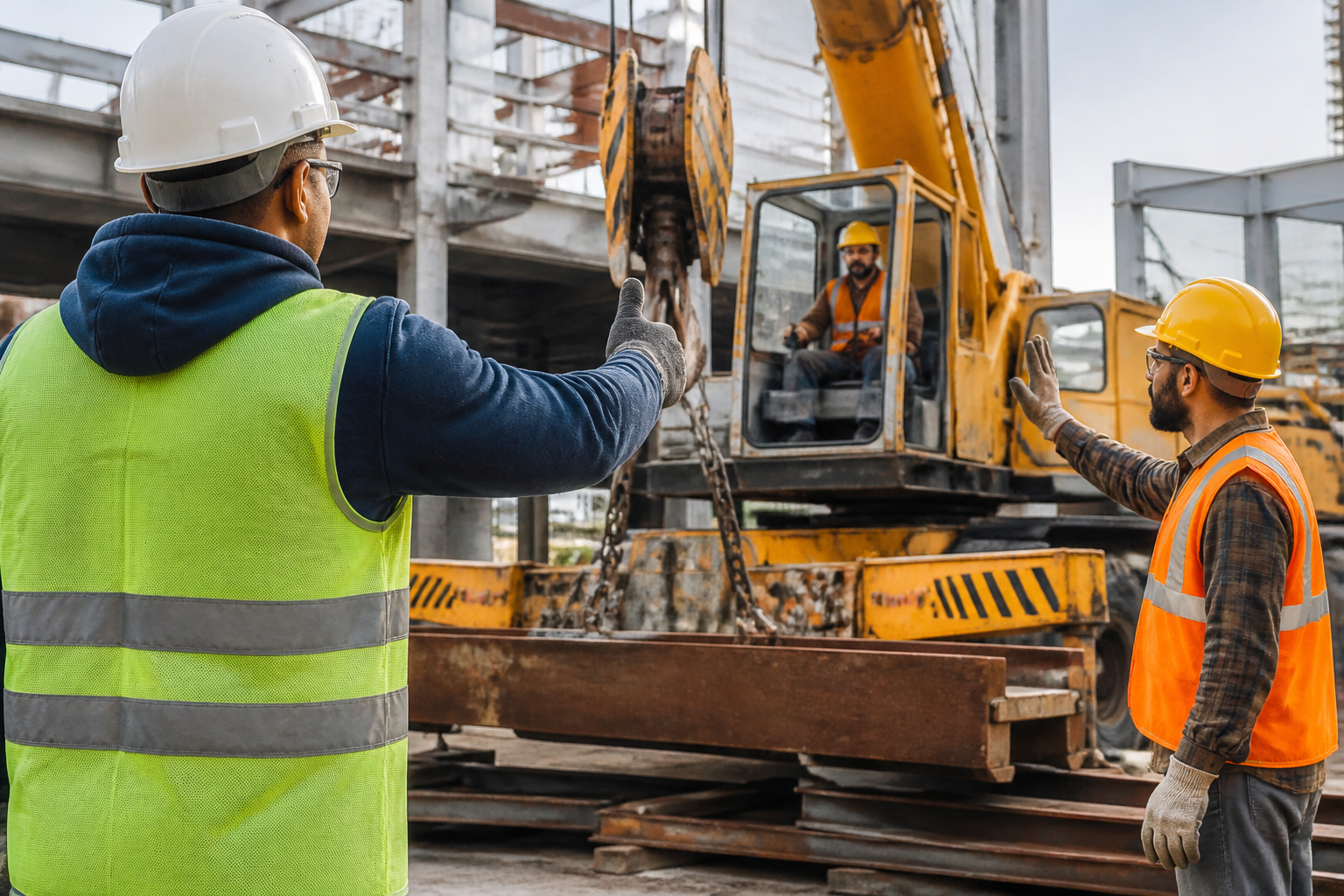
Critical overhead lifts leave zero room for error. When a mobile or tower crane is positioning structural steel, concrete panels, or heavy machinery, a split-second delay or misheard command can lead to severe structural damage or catastrophic injury. Overcoming the crane rigging communication language barrier construction supervisors face daily requires more than handing workers a standard OSHA chart. It demands standardized radio commands, universally practiced hand signals, and targeted vocabulary training for mixed-language crews.
The Hidden Risks of Communication Gaps During Critical Lifts
Rigging operations rely entirely on clear, real-time feedback between the crane operator, the designated signal person, and the ground crew. On jobsites with mixed English- and Spanish-speaking workers, several communication points can break down rapidly.
Radio Chatter and Direct Terminology Translation
Operators and riggers often use regional slang or informal shorthand over two-way radios. Direct translations of technical terms like "trolley in," "boom down," or "dog everything" do not always transfer cleanly between English and Spanish. When background noise from generators and heavy equipment is added, miscommunication rates spike.
Non-Standardized Hand Signals
While ASME B30.5 and OSHA standards define visual hand signals, workers trained in different countries or non-union environments often bring non-standard regional gestures to the jobsite. If a designated signal person uses an unfamiliar hand movement during a blind lift, the operator may hesitate or interpret the command incorrectly.
Hesitation to Interrupt During Emergencies
Limited English proficient (LEP) riggers or ground workers who notice a load shifting or an unstable line may hesitate to interrupt the radio channel if they lack confidence in their English phrasing for an emergency stop command.
Establishing Universal Radio Protocols for Multilingual Crews
Radio communication requires precise, predictable phrasing. When operators and signal persons do not share a fluent primary language, your jobsite must mandate a streamlined, standardized radio vocabulary.
Standardized Command Structures
Every radio call should follow a fixed three-part structure: Direction, Distance, and Action. For example, instead of loose phrases like "Bring it down a little bit," require standard phrasing: "Hoist down, 5 feet, slow." Instruct teams to use agreed-upon direct terminology in Spanish when necessary (e.g., "Bajar carga, 5 pies, despacio").
The Two-Way Echo Rule
Implement a strict echo protocol on all crane channels. The crane operator must repeat the distance and direction command back to the signal person before initiating any movement. If the operator does not repeat the phrase clearly, no load moves. This simple rule eliminates assumptions caused by accent barriers or radio static.
Universal Emergency Stop Terminology
Every worker on site—regardless of primary language—must know the exact, uncompromised emergency stop words in both languages: "STOP" and "ALTO". Train ground workers that repeating "STOP, STOP, STOP" or "ALTO, ALTO, ALTO" over the radio requires immediate cessation of all crane movement with no questions asked.
Aligning Visual Hand Signals Across Mixed Teams
Visual signals bridge language divides effectively, but only when every worker shares the exact same physical dictionary. You cannot assume a newly hired rigger interprets hand signals the same way your crane operator does.
- Mandatory Pre-Lift Signal Verification: Before the first pick of the shift, require the operator and the designated signal person to visually review core signals: Hoist, Lower, Boom Up, Boom Down, Swing, and Stop.
- High-Visibility Signal Gloves: Equip designated signal persons with high-visibility, color-coded gloves (e.g., bright orange or neon green palms) to make subtle wrist and finger movements obvious from a distance or through cab glass.
- Single Point of Contact Enforcement: Mixed-language crews can become chaotic if multiple ground workers shout instructions simultaneously. Enforce a strict policy that only one designated signal person—wearing a clear high-visibility vest or arm badge—is authorized to communicate with the operator.
Integrating Language Training into Daily Rigging Safety
Generic language courses rarely cover specialized heavy equipment terminology. To eliminate the crane rigging communication language barrier construction companies must provide job-specific language training directly connected to daily field operations.
Conduct Practical Pre-Lift Toolbox Talks
Replace passive safety lectures with interactive pre-lift walk-throughs. Have supervisors walk through the lift plan using both English and Spanish key terms. Practice radio calls and hand signals directly with the crew before rigging up heavy loads.
Focus on Role-Specific Vocabulary
Rigger leads, signal persons, and operators need targeted vocabulary modules. Focus on high-frequency rigging concepts: load weight limits, tag line control, pinch points, center of gravity, and rigging hardware such as shackles, slings, and spreader bars.
Conduct Regular Field Audits
Conduct periodic visual and audible audits during routine lifts. By actively auditing field practices, safety managers can identify whether the crane rigging communication language barrier construction teams face is being resolved or if localized miscommunications persist.
Build a Safer Jobsite with Customized Workplace Language Training
Standardizing your crane and rigging signals requires targeted instruction that reaches every worker on the job site. At New Heights Languages, we design customized workplace English and Spanish training specifically tailored to manufacturing and construction environments. We help your supervisors, crane operators, and rigging crews master clear, safety-critical communication that prevents accidents and keeps projects on schedule.
Ready to eliminate communication risks on your jobsite? [Book a free consultation with our team today](/contact) to discuss customized training for your workforce.
<!-- featured image alt: A crane operator and a bilingual signal person using standardized hand signals on a busy construction jobsite. -->