Fall Protection Training Non English Construction Workers
By New Heights Languages ·
Ensure commercial construction crews accurately inspect harnesses and anchors. Upgrade fall protection training for non-English construction workers.
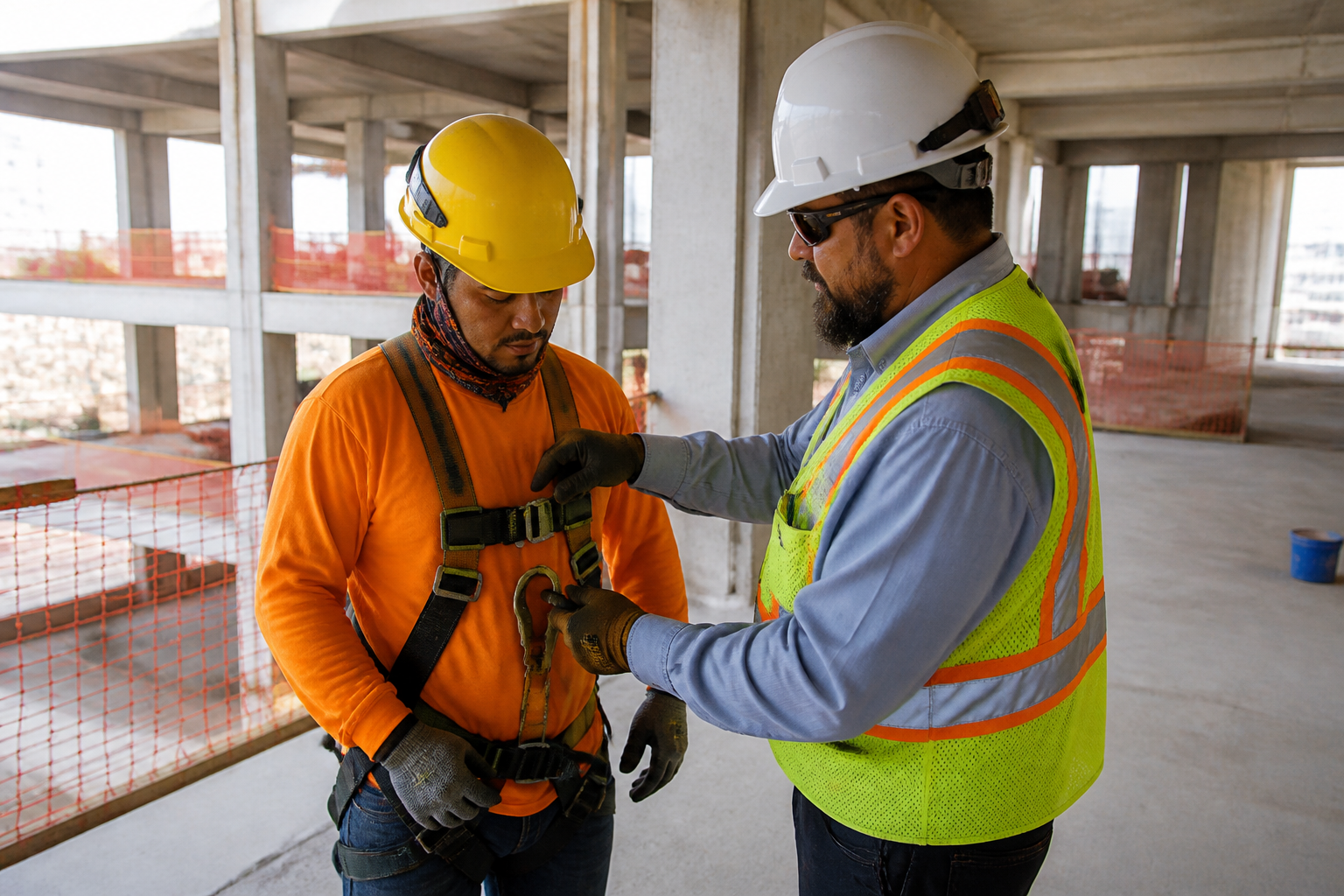
In high-rise steel framing, commercial roofing, and concrete deck construction, a safety harness is only as reliable as the worker's pre-use inspection. While safety managers regularly distribute personal fall arrest systems (PFAS), a critical vulnerability remains on mixed-language jobsites: limited English proficient (LEP) workers signing inspection logs without fully understanding how to identify compromised gear. Delivering effective fall protection training non English construction workers can trust requires far more than showing an English video with generic subtitles or relying on a silent nod during morning safety briefings.
Commercial superintendents and safety directors cannot afford to assume that a signed sign-in sheet equals a safe harness. To achieve true OSHA compliance and eliminate preventable falls, employers must verify that every crew member—regardless of primary language—can independently evaluate webbing, D-rings, lanyards, and anchor points before stepping onto a leading edge.
The Dangerous Gap Between Safety Sign-Offs and Gear Integrity
Daily pre-use harness and lanyard inspections are supposed to be the first line of defense against catastrophic falls. However, when safety orientation materials rely on dense English terminology, non-native English speaking employees often copy the actions of surrounding crew members rather than performing a rigorous, independent check.
Generic compliance courses often cover fall hazards in broad strokes, but fail to bridge the language gap on technical rejection criteria. A worker might know that a harness keeps them safe, but they may not understand the specific signs that require taking gear out of service:
- Impact indicator stitching that has deployed after a minor dropped-tool event or prior fall.
- Heat damage, chemical burns, or microscopic UV degradation that stiffens or discolors nylon webbing.
- Cracked, bent, or pitted D-rings and snap hook gate mechanisms that fail to self-close and lock automatically.
- Frayed load-bearing stitching around buckle points and chest straps.
When non-native English construction workers do not know the exact technical terms or lack the confidence to report damaged equipment, compromised gear stays in rotation on the jobsite.
Why Traditional Tool-Box Talks Fail to Verify Understanding
Most commercial jobsite tool-box talks rely on passive communication. A foreman reads a safety sheet in English, demonstrates a quick harness pull, and asks, "Does everyone understand?"
In many cultures, publicly questioning a supervisor or admitting a lack of understanding is viewed as a sign of disrespect or incompetence. Consequently, workers nod in agreement. But when supervisors conduct field audits later in the shift, they frequently spot loose leg straps, twisted shoulder webbing, or lanyards clipped to unapproved structural tie-off points.
To bridge this gap, modern fall protection training non English construction workers receive must shift from passive listening to active operational verification. Safety leaders must establish clear, standardized protocols that prove a worker can identify defect points physically and verbally.
3 Practical Methods to Verify Harness and Anchor Pre-Inspections
Building an authentic safety culture on a multilingual construction site means testing comprehension directly on the deck. Here are three field-tested methods for verifying pre-inspection competency across language barriers:
1. Implement the "Teach-Back" Inspection Audit
Instead of asking yes-or-no questions, ask the worker to demonstrate the inspection back to the supervisor or bilingual crew lead. Have the worker physically trace the harness from the back D-ring down to the leg straps while identifying potential failure points. Even if the worker uses simple language or native terms, their physical actions will immediately show whether they are checking stress points, grommets, and locking keepers correctly.
2. Deploy Visual Dual-Language Equipment Rejection Cards
Text-heavy safety manuals create barriers. Create visual, high-contrast reference cards attached to gang boxes or harness storage trailers. These cards should show clear, side-by-side photos of acceptable gear versus rejected gear with key terms in both English and Spanish (or the primary languages spoken on site):
- English: "Deployed Impact Indicator - DO NOT USE"
- Spanish: "Indicador de Impacto Desplegado - NO USAR"
- English: "Distorted D-Ring - REMOVE FROM SERVICE"
- Spanish: "Anillo en D Deformado - RETIRAR DE SERVICIO"
3. Establish Peer-to-Peer Inspection Pairs
Pair less fluent employees with experienced bilingual crew members during morning gear checks. Formalizing a buddy inspection protocol ensures that two sets of eyes review every harness, lanyard, and anchor hook-up before workers work at heights. This peer verification builds confidence and normalizes taking damaged gear directly to the superintendent for replacement.
Standardizing Anchor Point Verification Across Language Barriers
Inspecting the harness is only half the equation. Connecting to an unrated or improperly installed anchor point is equally fatal. When executing fall protection training non English construction workers interact with daily, anchor point selection must be explicitly standardized.
Workers must clearly understand the difference between temporary construction anchors (such as reusable roof anchors, concrete strap anchors, and beam clamps) and non-approved structural elements (such as conduit, gas lines, or unbraced guardrails).
Key operational checks to standardize across your crews include:
- 5,000 lb. Capacity Requirement: Teaching workers how to locate engineered anchor labels and rated load stamps on commercial hardware.
- Fastener Inspection: Verifying that temporary anchors are secured with the exact quantity, type, and grade of screws or bolts specified by the manufacturer.
- Locking Snap Hook Alignment: Demonstrating that lanyard snap hooks must align directly with the load path without side-loading the gate mechanism.
- Clear Fall Clearance Calculations: Ensuring workers understand how free-fall distance, deceleration distance, and harness stretch factor into total clearance above lower levels.
Standardized Field Vocabulary for Fall Protection
To simplify daily checks, train your supervisors and crews on a shared, core vocabulary that combines English industry terms with practical visual cues:
- Back D-Ring (Anillo en D dorsal): Must sit centered between the shoulder blades.
- Pass-Through / Tongue Buckle (Hebilla de paso / de lengüeta): Must be snug, allowing no more than two flat fingers underneath the strap.
- Self-Retracting Lifeline / SRL (Línea de vida retráctil): Must be bench-tested with a quick sharp tug to verify positive locking before climbing.
- Anchor Point (Punto de anclaje): Must be an approved structural member or engineered tie-off point, never a pipe or handrail.
By embedding these key terms into your daily field vocabulary, your company removes ambiguity and empowers non-native English speaking employees to speak up the moment gear shows signs of wear.
Upgrade Your Construction Team's Safety Communication
Verifying fall protection comprehension requires targeted language strategies designed specifically for the construction jobsite. At New Heights Languages, we help general contractors and specialty subcontractors bridge critical communication gaps. Our customized workplace English and Spanish language programs focus directly on high-hazard tasks, equipment inspection protocols, and safety leadership training.
Protect your workforce and elevate your safety culture. [Book a free consultation today](/contact) to learn how we can customize workplace language training for your jobsite crews.
<!-- featured image alt: A commercial construction superintendent conducting a harness pre-inspection check with a Spanish-speaking worker on a concrete building frame. -->