Gemba Walk Multilingual Production Floor Guide
By New Heights Languages ·
Learn how plant managers conduct effective Gemba walks on multilingual production floors to uncover bottlenecks, improve safety, and engage line workers.

Gemba walks are a cornerstone of lean manufacturing. The objective is simple: plant managers and operations leaders leave their offices, walk the shop floor, observe processes in real time, and talk directly to operators.
However, when conducting a gemba walk multilingual production floor managers often run into a significant obstacle: the language barrier. When line operators speak Spanish, Vietnamese, standard Mandarin, or Haitian Creole as their primary language, standard open-ended questions like "What is giving you trouble today?" often yield polite head nods, thumbs-up gestures, or standard answers like "Everything is good."
Silence or polite agreement does not mean your processes are running smoothly. It usually means workers lack the English vocabulary or confidence to explain subtle mechanical issues, material variations, or safety workarounds. To capture real operational insight, plant leaders must adapt how they prepare for, conduct, and follow up on Gemba walks across multilingual teams.
The Silence Trap: Why Standard Gemba Walks Fail on Multilingual Floors
In a lean manufacturing environment, frontline workers are the experts of their specific work stations. They notice when a conveyor belt stutters, when a packaging seal isn't holding, or when a jig requires extra force to lock into place.
When language barriers exist on the plant floor, three distinct breakdown points occur during a Gemba walk:
1. Deference and Fear of Misunderstanding
Workers who are not fluent in English may worry that admitting a problem will make them look incompetent or lead to disciplinary action. Nodding and stating "all good" is a safe fallback strategy to end the interaction quickly.
2. Missing Technical Vocabulary
An operator might know exactly why a stamping machine is misfeeding, but they lack the specific English terms—such as "burr," "alignment," "sensor fault," or "tolerance"—to explain it to a visiting plant manager.
3. Over-Reliance on Shift Supervisors
When managers rely entirely on bilingual shift leads to translate during a walk, the interaction changes. Workers often filter their responses through the supervisor, or supervisors answer on behalf of the worker, obscuring the operator's direct perspective.
Preparing for Your Walk: Visual Tools and Focus Areas
To conduct a productive gemba walk multilingual production floor operations must lean heavily on visual management and targeted observation before verbal dialogue begins.
Review Visual KPIs Prior to Walking
Before stepping onto the floor, analyze machine downtime logs, scrap rates, and quality check sheets for specific lines. Identify exact stations experiencing variance so you can focus your observation on specific actions rather than broad inquiries.
Bring Visual Standard Operating Procedures (SOPs)
Carry dual-language or heavily illustrated SOP cards for the processes you plan to observe. Comparing actual operator movements to the documented standard provides a clear, objective baseline for conversation that does not rely strictly on complex English phrasing.
Focus on Physical Indicators of Waste
Look for physical signs of operational friction:
- Unofficial tools or handmade jigs near workstations.
- Stacks of reworked parts tucked under workbenches.
- Awkward posture or repetitive stretch movements indicating ergonomic strain.
- Cardboard or tape used as temporary fixes on machine guides.
Tactful Communication Strategies at the Machine
When you arrive at a workstation during a gemba walk multilingual production floor tour, your communication strategy must shift from abstract questions to direct, physical demonstrations.
Use "Show Me" Instead of "Tell Me"
Instead of asking, "Is this machine running correctly?" ask the operator, "Can you show me how you check part alignment?" Watching the worker point to specific components eliminates ambiguity and naturally prompts them to demonstrate bottlenecks.
Simplify Question Structures
Avoid complex conditional sentences like "If you were to change one thing about this staging process, what would it be?" Instead, break down your questions into direct queries:
- "Which step takes the longest?"
- "Where does material get stuck?"
- "How many times does this tool jam per shift?"
Validate Understanding Through Re-Enactment
When an operator explains a process issue using limited English paired with gestures, confirm your understanding by repeating the gesture or pointing to the part and asking, "Here?" This confirms accuracy without placing pressure on the worker's language skills.
Leveraging Bilingual Shift Leads Without Micromanagement
Bilingual lead operators and shift supervisors are vital assets on a multilingual shop floor, but their presence during a Gemba walk must be managed deliberately.
If a supervisor steps in to translate, instruct them to ask the worker the question directly rather than summarizing what they think the worker experiences. The goal of a Gemba walk is to empower the operator on the floor, not to conduct a middle-management review.
Use shift leads to help define precise operational terms in both English and the crew's native language. If you identify a recurring process issue during your walk, ask the bilingual lead to help you document the specific terms operators use for that machine component.
Closing the Loop: From Gemba Observations to Customized Language Training
A Gemba walk should never be a one-time audit; it must feed directly into continuous improvement initiatives. When you uncover recurring communication breakdowns during floor walks, address the root cause by building targeted workplace language capabilities.
If operators struggle to describe machine faults or complete non-conformance logs in English, generic conversational language classes will not solve the problem. Production workers need practical, job-specific vocabulary tailored to your plant's equipment, safety rules, and quality metrics.
Document the specific terms, machine names, and safety warnings that came up during your walks. Use these observations to implement practical workplace English training that equips workers to report defects, explain line stoppages, and participate actively in root-cause problem solving.
Build a Communication-Ready Production Floor
To maximize the value of every gemba walk multilingual production floor leaders must combine intentional visual tools with structured vocabulary development. When workers have the language tools they need to communicate operational friction, plant safety, quality control, and overall throughput improve dramatically.
New Heights Languages designs customized, on-site and online workplace English and Spanish training programs tailored specifically for manufacturing and construction operations. We help your line workers and supervisors build the exact vocabulary needed for daily operations, safety compliance, and lean initiatives.
Ready to eliminate language barriers on your production floor? [Book a free consultation](/contact) with our team today to discuss your plant's training needs.
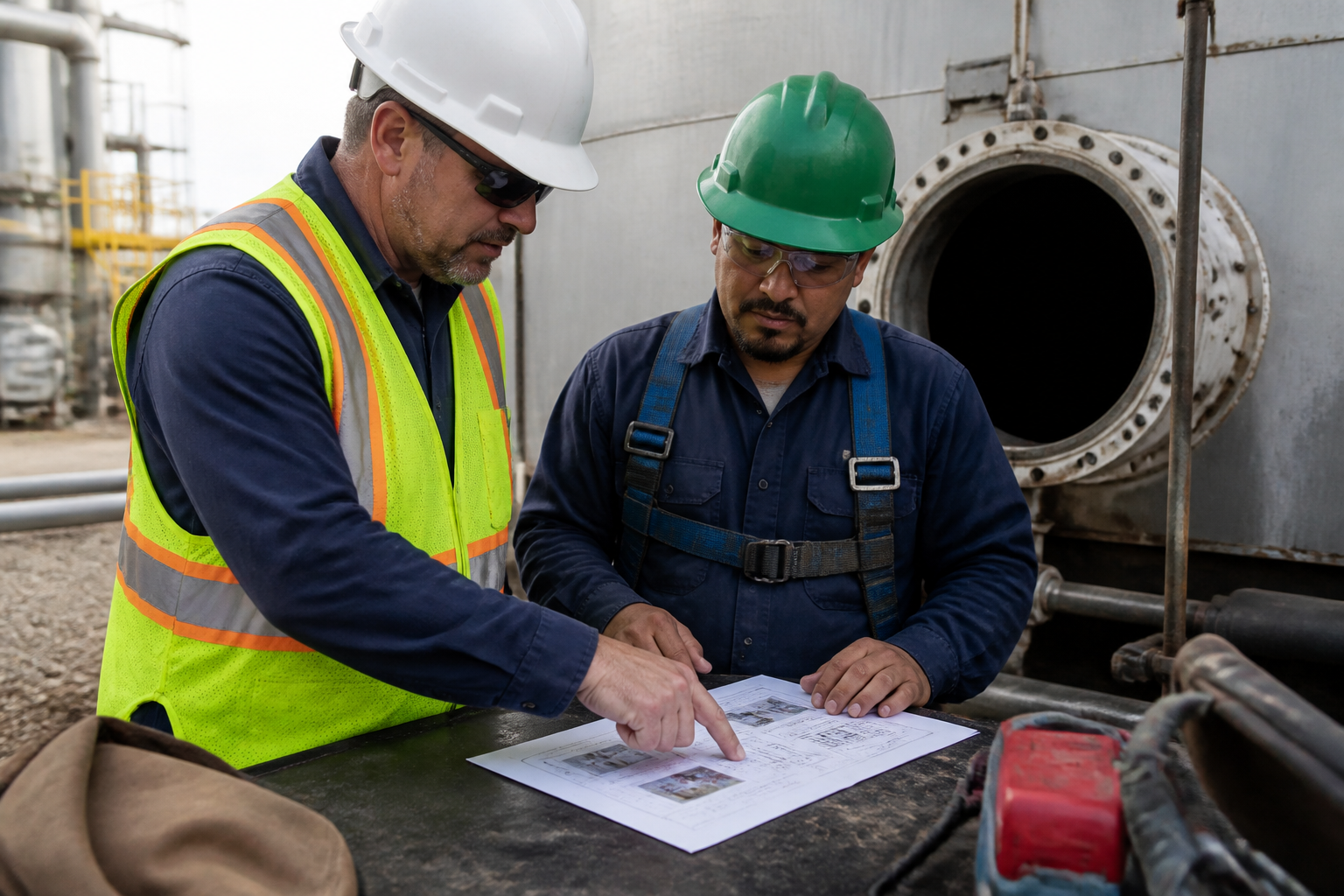
<!-- featured image alt: A plant manager walking through a manufacturing facility talking with a production line worker operating machinery. -->