OSHA HazCom Language Barrier SDS Compliance Guide
By New Heights Languages ·
Learn how to eliminate the OSHA HazCom language barrier SDS risks in manufacturing and construction with targeted workplace English and Spanish training.
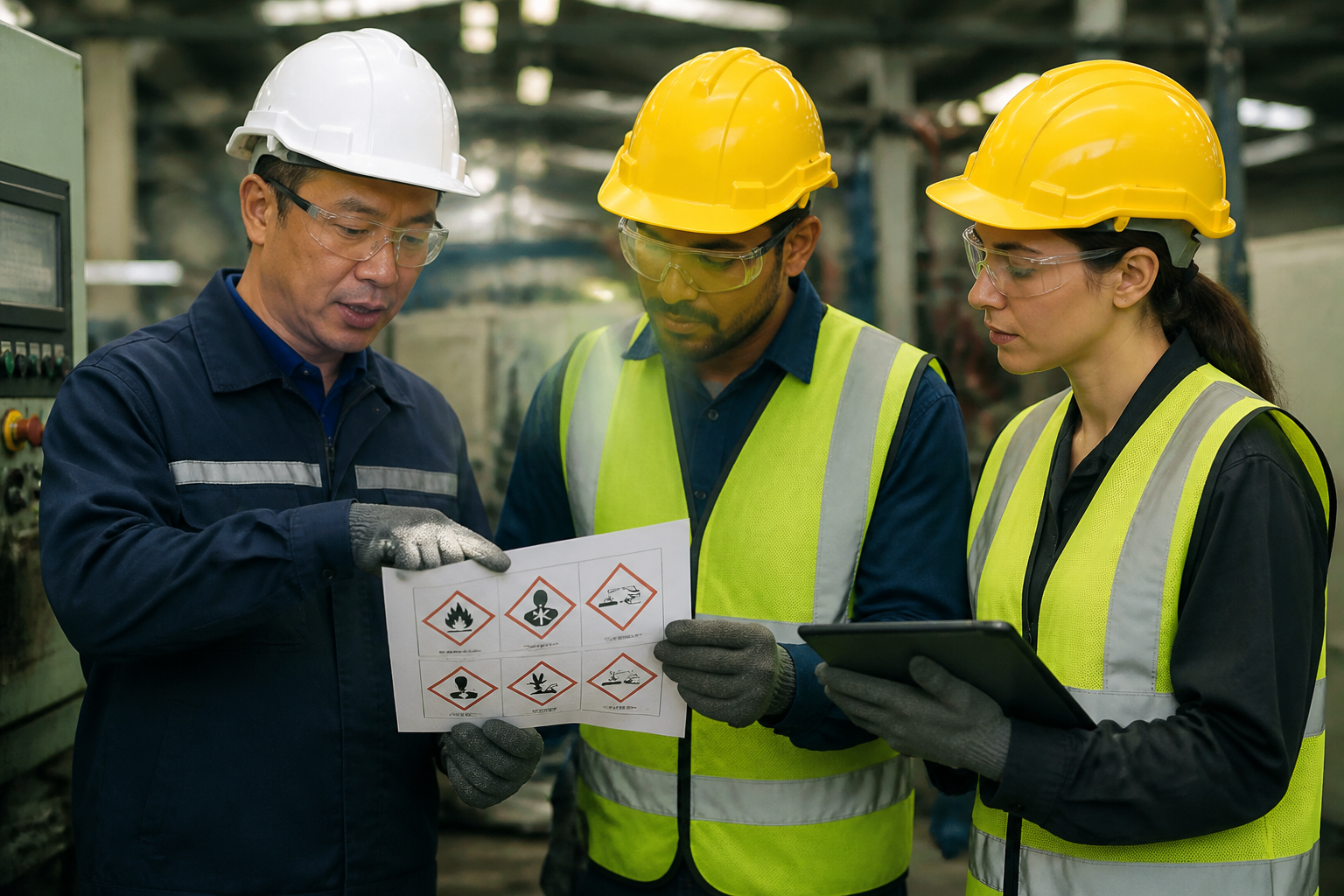
OSHA’s Hazard Communication Standard (29 CFR 1910.1200) requires employers to ensure that chemical hazards are fully understood by the people working with them. In plants and jobsites with multilingual workforces, addressing an OSHA HazCom language barrier SDS gap isn't just about hanging up bilingual posters or placing translated documents in a binder. It requires ensuring every worker can instantly identify chemical hazards, read signal words on secondary containers, and execute emergency first-aid protocols under stress.
When non-native English workers interact with industrial solvents, heavy degreasers, acids, or specialized coatings, superficial compliance falls apart. A worker may know where the binder is located, but if they cannot interpret specific lines in Section 8 of a Safety Data Sheet (SDS) or read a chemical warning label on a drum during a fast-paced shift, your facility faces severe safety, quality, and regulatory risks.
Beyond Translated Binders: What OSHA HazCom Standards Actually Require
Many safety managers assume that downloading SDS sheets in Spanish or posting GHS pictogram charts satisfies compliance. However, OSHA regulations emphasize effective comprehension. If a non-native English employee receives safety instruction or chemical warnings in a language they do not fully grasp, the employer has not met the standard.
Translating documents is only the baseline. On an active shop floor or construction jobsite, chemical labels, secondary containers, and emergency response procedures often remain in English. When an OSHA HazCom language barrier SDS challenge goes unaddressed, secondary container labels become guesswork, and response times during a chemical splash spike dramatically.
True HazCom compliance means workers can actively perform four core tasks:
- Identify GHS pictograms and associate them with correct immediate precautions.
- Differentiate between signal words like "Danger" and "Warning" instantly.
- Locate and interpret critical safety instructions on an SDS without assistance.
- Articulate necessary Personal Protective Equipment (PPE) required for specific chemical transfers.
The Three High-Risk Breakdown Points in Chemical Communication
Chemical safety breakdowns rarely happen because an employee intentionally ignored safety rules. They happen because technical jargon and language barriers create confusion during routine handling.
1. Signal Words and GHS Pictograms
The Globally Harmonized System relies heavily on symbols, but symbols require correct context. For instance, workers often confuse the health hazard pictogram (exploding chest) with the acute toxicity pictogram (skull and crossbones). Furthermore, English signal words like "Danger" (severe hazard) and "Warning" (less severe hazard) must be recognized immediately by workers whose primary language is Spanish, without relying on real-time translation apps.
2. SDS Section 4 (First-Aid) and Section 8 (Exposure Controls/PPE)
During a spill or splash, no supervisor has time to translate a 16-section SDS document line by line. Workers must know how to scan Section 4 for first-aid measures (such as eye flushing procedures) and Section 8 for exposure controls. If employees struggle with technical English terms like "vapor respirator," "corrosive," or "dilute," critical mitigation steps get missed.
3. Secondary Container Labeling
Plant operations frequently transfer raw chemicals from bulk totes or 55-gallon drums into spray bottles, buckets, or smaller jugs. While primary containers from manufacturers usually carry full bilingual compliance labels, secondary containers are often hand-labeled by shift leads in English. If a worker cannot read hand-written English health hazards, misapplication or dangerous accidental mixing of incompatible chemicals can occur.
Targeted Vocabulary: Bridging English and Spanish on the Floor
To eliminate the OSHA HazCom language barrier SDS bottleneck, safety leaders must train workers on technical English keywords while validating understanding in their native language. General English classes do not solve this issue; targeted workplace language training does.
Focus your shop floor language training on high-utility chemical terms:
- Action Verbs: Flush, dilute, ventilate, seal, dispose, rinse, isolate, evacuate.
- Hazard Descriptors: Flammable, corrosive, toxic, volatile, irritant, caustic, combustible.
- PPE Terminology: Respirator, face shield, splash goggles, chemical-resistant apron, nitrile gloves.
- Spatial & Physical Indicators: Vapors, fumes, mist, contact, ingestion, inhalation.
By practicing these terms in context, non-native English employees gain the confidence to read standard English labels while supervisors gain peace of mind knowing the crew can operate safely across shifts.
Verifying HazCom Comprehension During Internal Audits
Do not wait for an OSHA inspector to test your crew's chemical safety literacy. Safety directors should conduct quick, functional walk-through audits to assess real comprehension on the plant floor.
Instead of asking simple yes/no questions like "Do you know how to read this SDS?", use practical verification prompts:
1. The Retrieval Test: Ask an operator to walk to the SDS station or access the digital terminal and pull up the document for a specific solvent they used that morning.
2. The First-Aid Scan: Open the SDS to Section 4 and ask the worker to point to what they should do if the chemical touches their skin.
3. The Label Check: Point to a secondary container on their workstation and ask them to explain what signal word is present and what PPE is required before opening it.
If the worker hesitates, relies on a coworker to translate, or nods without answering clearly, you have identified a clear communication gap that requires targeted language instruction.
Building Sustainable Chemical Safety Through Customized Language Training
Solving chemical safety challenges requires moving past static translated binders and generic language courses. When employees master the specific English and Spanish vocabulary needed for GHS compliance, your facility builds a resilient safety culture that reduces incidents, speeds up onboarding, and passes audits with ease.
At New Heights Languages, we design customized, industry-specific English and Spanish training tailored directly to your plant’s shop floor, SDS documents, and safety protocols. We eliminate the OSHA HazCom language barrier SDS risk by teaching your workers the exact language they need to work safely every single day.
Ready to upgrade your HazCom compliance and bridge the language gap on your jobsite? [Book a free consultation with our team today](/contact) to discuss customized workplace language training for your workforce.
<!-- featured image alt: A chemical supervisor explaining a Safety Data Sheet pictograms chart to two industrial workers on a manufacturing floor. -->